Automation is transforming bioreactor scaling, making Cultivated Meat production faster, cheaper, and more reliable. By integrating AI-powered monitoring and control systems, producers can reduce batch failure rates, lower costs, and improve consistency in production. Here’s how automation delivers value:
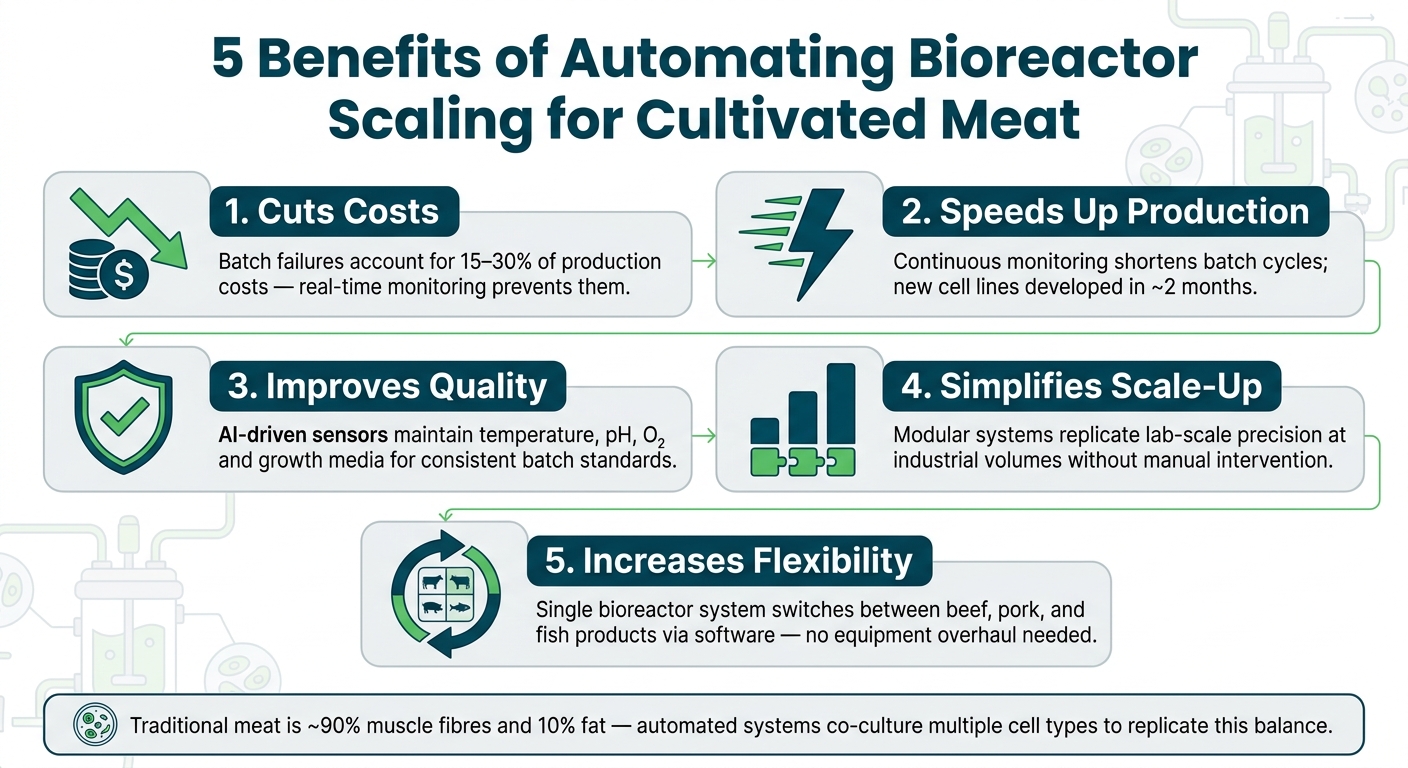
- Cuts Costs: Reduces labour needs and prevents costly batch failures by enabling real-time monitoring and adjustments. This involves tracking essential bioreactor metrics to maintain optimal growth conditions.
- Speeds Up Production: Shortens batch times with continuous monitoring, increasing throughput.
- Improves Quality: Ensures consistent product standards through precise, real-time adjustments.
- Simplifies Scale-Up: Makes it easier to move from lab-scale to industrial production with continuous monitoring and modular systems.
- Increases Flexibility: Allows production of various Cultivated Meat products without extensive equipment changes.
These advancements are helping the industry overcome key challenges, bringing Cultivated Meat closer to everyday consumers in the UK.
5 Benefits of Automating Bioreactor Scaling for Cultivated Meat
Scaling Single-Use Bioreactors from Lab to Production - TECNIC
sbb-itb-c323ed3
1. Lower Production Costs and Labour Requirements
Automation has a clear and direct impact on reducing costs, making it a game-changer for Cultivated Meat production. Batch failures, which can be extremely expensive, account for an estimated 15–30% of costs [1]. These failures stem from the high expenses tied to growth media, energy, and specialist labour. By addressing these inefficiencies, automation pushes the industry closer to large-scale, cost-effective production.
Cost Efficiency
Manual bioreactor designs and operations come with limitations. They depend on periodic, offline sampling, where technicians collect samples at set intervals and analyse them later. The problem? By the time results come in, it may already be too late to take corrective action. Automation eliminates this delay by continuously monitoring cell behaviour. This real-time tracking allows for immediate adjustments, preventing potential batch failures.
Additionally, automated systems optimise nutrient delivery and environmental conditions. Instead of sticking to rigid schedules, these systems dynamically adapt to the needs of the cells. This approach minimises the waste of costly inputs, such as growth media, while achieving higher yields from the same resources. The result? Lower costs and less need for manual oversight.
Time Savings
Skilled labour is another area where automation makes a big difference. AI-driven platforms can integrate seamlessly with existing hardware, offering either recommendations or fully autonomous control - without requiring additional staff [1]. Automation also speeds up the development of new cell lines, cutting timelines down to about two months [1]. This efficiency not only saves time but also accelerates innovation in the industry.
2. Faster Batch Times and Higher Throughput
In the world of Cultivated Meat production, speed is a game-changer. A typical production cycle - spanning from cell isolation to harvest - usually takes about five to seven weeks [2]. Any delays in the process can stretch this timeline further, making efficiency a critical factor in boosting throughput and overall production capacity.
Time Savings
Automated bioelectronic sensors are transforming the way producers manage time. These sensors continuously monitor conditions and make real-time adjustments, cutting out the delays caused by manual sampling. This is exactly the issue that Cellcraft, a UK-based startup, aimed to solve. Back in April 2026, co-founders Clarisse Beurrier and Yash Mishra introduced Cellcraft IQ, a SaaS platform designed as an "intelligence layer" for existing bioreactors. This system autonomously manages key parameters like temperature, pH, and oxygen levels [1]. By addressing the industry's common issue of high batch failure rates, Cellcraft IQ empowers producers to respond quickly to process deviations, keeping production on track.
Scalability
Automation doesn’t just save time - it also opens the door to perfusion culture, a more efficient production method. Unlike traditional batch processes, perfusion culture continuously recycles growth media and allows for ongoing cell harvesting. When paired with automated sterilisation and cleaning cycles between runs, this approach slashes downtime and boosts output [3]. The result? A production system that’s far more efficient and capable of meeting growing demand.
3. Consistent Quality and Process Reliability
When it comes to Cultivated Meat production, speed and output alone aren't enough. The real challenge lies in ensuring that every batch meets the same high standards. Consistency is not optional – it’s a must-have for commercial success. Even small changes in environmental conditions can ruin an entire batch, which makes constant monitoring essential. That’s where automation steps in to solve these issues.
Quality Consistency
Traditional bioreactor systems often fall short because they only provide a snapshot of conditions at a single point in time. This leaves producers in the dark, unable to act before problems escalate. Automation changes the game by using bioelectronic sensors. These sensors monitor cell behaviour and environmental factors in real time, allowing AI-driven systems to make immediate, precise adjustments throughout the production cycle.
With continuous monitoring and real-time adjustments, automated systems keep key parameters like temperature, pH, oxygen levels, and growth media in check. This reduces variability between batches and minimises the risk of expensive failures. For example, Cellcraft’s platform turns conventional bioreactors into intelligent systems that can autonomously optimise conditions, ensuring a consistent and reliable production process.
4. Simpler Scale-Up from Lab to Industrial Volumes
Scaling up from a lab bioreactor to full-scale industrial production is no small feat in the Cultivated Meat industry. While manual monitoring may work in small-scale lab settings, it becomes impractical as production grows due to the increased complexity.
Scalability
One of the biggest hurdles in scale-up lies in the limitations of traditional bioreactor systems. These systems are essentially opaque, requiring periodic sampling to monitor conditions. However, this approach often misses critical variations that occur between sampling points, leading to high failure rates [1].
Automated platforms offer a solution by replacing periodic sampling with continuous, real-time monitoring. Using bioelectronic sensors, these systems track cell behaviour throughout the production process. This data feeds into AI-driven systems that can make instant adjustments to maintain optimal conditions. As a result, the precise environment achieved in the lab can be consistently replicated at larger scales, eliminating the need for constant manual intervention. This level of control bridges the gap between the precision of lab-scale operations and the demands of industrial-scale production.
Adding to the benefits of automation, modular production stacks make scaling even more straightforward. Instead of reinventing processes for each new scale, producers can use integrated platforms that optimise cells, growth media, and bioreactor parameters together. For example, UK-based Cellcraft introduced its Cellcraft Farm platform in April 2026. This modular system combines AI-controlled bioreactors with patented bioelectronic sensors, specifically designed to simplify scale-up. The company has already partnered with Spain's largest pork producer to implement this technology on a commercial scale [1].
"We decided to prove we could unlock cultivated meat's scale and cost bottlenecks... [using] a single integrated production stack that co-optimises cells, media, and AI-controlled bioreactors to deliver scalable, automated manufacturing." - Clarisse Beurrier, Co-founder, Cellcraft [1]
5. Greater Flexibility Across Different Cultivated Meat Products
Automation in Cultivated Meat production doesn’t just improve cost-efficiency, speed, and consistency - it also makes it easier to create a wider range of products. Whether it’s a burger patty, chicken nugget, or pork chop, each product requires specific cell types, textures, and compositions. Automated bioreactor systems are designed to handle this variety without needing entirely separate production lines. They achieve this through advanced system configuration.
Versatility
The standout feature here is how automated stirred-tank bioreactors (STRs) can seamlessly switch between different culture modes - suspension or microcarrier-based adherent cultures - within the same system [5]. This means that a single facility can produce beef, pork, or fish products simply by adjusting software-controlled parameters rather than physically altering equipment. Key environmental factors like pH, oxygen levels, temperature, and CO₂ are fine-tuned to suit the biological requirements of each cell type.
This precision is crucial because traditional meat is approximately 90% muscle fibres and 10% fat [4]. To replicate this balance, multiple cell types need to be cultured together, which is nearly impossible to manage manually. Automated systems make this feasible by continuously monitoring and adjusting conditions to steer stem cells towards forming either muscle or fat tissue at the appropriate stages [5].
Software-driven flexibility takes this a step further. Platforms like Cellcraft's Cellcraft IQ, introduced in April 2026, act as hardware-independent "intelligence layers" that integrate with existing bioreactors [1]. These systems allow producers to toggle between AI advisory mode - which offers process optimisation suggestions - and fully autonomous control, depending on the specific product requirements.
"It works in two modes: AI advisory – which provides recommendations for process optimisations – and fully autonomous control, which can increase yields and reduce costs by cutting batch failure rates." - Clarisse Beurrier, Co-founder, Cellcraft [1]
This flexibility also accelerates innovation. Advanced automated platforms can develop customised cell lines in as little as two months [1], giving brands the ability to quickly expand their Cultivated Meat product offerings. This rapid development capability highlights the system’s ability to adapt across a diverse range of products.
Conclusion
Automation is reshaping how Cultivated Meat is produced. By cutting labour costs, reducing the chances of batch failures, and speeding up production, it’s making the process far more efficient. Clarisse Beurrier from the UK startup Cellcraft highlights a key point: without real-time monitoring, producers risk losing entire batches due to unnoticed process deviations [1]. These advancements are paving the way for a stronger impact across the industry.
In the UK, the development of homegrown automation solutions adds an extra layer of reliability to production. Cellcraft’s modular, AI-powered system is particularly noteworthy, as it enables traditional meat producers to branch into Cultivated Meat without overhauling their existing operations [1].
The industry is also seeing rapid progress with full-stack platforms that integrate smart hardware, AI, and refined cell lines. Challenges that once made scaling seem unattainable are now being dismantled, offering tangible improvements for both producers and consumers.
As automation continues to transform production, the advantages are becoming increasingly evident. This shift is a critical part of the cultivated meat timeline as the industry moves toward commercial viability. To stay ahead as Cultivated Meat edges closer to the UK market, check out Cultivated Meat Shop. It’s the first consumer-focused platform dedicated to this innovative food category, offering straightforward and reliable content to guide you through what’s ahead.
FAQs
What does bioreactor “scaling” mean?
Scaling up bioreactors means moving from small lab setups to much larger industrial systems to produce cultivated meat in higher quantities. This process focuses on maintaining the right conditions for cell growth and productivity, even as the production volume increases significantly.
How does AI reduce batch failure risk in real time?
AI reduces the risk of batch failures by keeping a constant watch on bioreactor conditions. Using pattern recognition and predictive modelling, it can identify potential problems early on. This enables swift adjustments to maintain stable and consistent operations throughout the process.
Can automation retrofit existing bioreactors or does it need new equipment?
Automation can be applied to upgrade existing bioreactors, even those built for handling larger capacities. Many automation solutions are designed to work seamlessly with current systems, including bioreactors exceeding 250 litres. These tools can be adjusted or scaled to meet varying production requirements effectively.