Continuous cultivation could significantly lower the cost of cultivated meat, making it more accessible in the UK. This method involves growing animal cells continuously in bioreactors, unlike traditional batch processes that require frequent stops. By improving efficiency, it addresses two key challenges: reducing costs and increasing production capacity.
Here’s what you need to know:
- Cost Reduction: Continuous systems cut media expenses by 50–80% and reduce labour needs by 40%. Media costs, a major expense, could drop from £50/kg to under £10/kg.
- Higher Yields: Achieves up to 10–50 grams of biomass per litre - 10x more than batch methods.
- Less Downtime: Operates with <5% downtime compared to 20–50% for batch systems.
- Projected Pricing: Prices could fall to £5–£10 per kilogramme by 2030, making it competitive with conventional meat.
However, challenges like contamination risks, cell stability, and bioreactor limitations remain. With advancements in technology, continuous cultivation is shaping the future of cultivated meat production and pricing.
What Is Continuous Cultivation?
Continuous cultivation is a bioprocessing method where animal cells are grown in a bioreactor with a constant supply of nutrients and simultaneous removal of waste. Unlike traditional batch systems, which pause production to harvest cells, this approach maintains ongoing cell growth over extended periods.
The process relies on Tangential Flow Filtration (TFF), which directs liquid across a filter to separate waste from cells. This design prevents blockages and ensures optimal conditions for cell growth. Such systems can operate continuously for 20 to 90 days before needing maintenance, compared to batch methods that require frequent cleaning and preparation downtime.
How Continuous Cultivation Works
In a continuous setup, fresh nutrients are consistently added while waste is filtered out in real time. This allows cell densities to reach up to 130 billion cells per litre, with biomass yields of 43% weight per volume [1].
In September 2024, Professor Yaakov Nahmias and his team at the Hebrew University of Jerusalem showcased this method in a study published in Nature Food. Using an animal-free medium costing just £0.50 per litre, they modelled a 50,000-litre facility capable of producing 2.14 million kilograms of cultivated chicken annually at a cost of approximately £4.90 per pound [1].
"Our findings show that continuous manufacturing enables cultivated meat production at a fraction of current costs, without resorting to genetic modification or mega-factories." - Professor Yaakov Nahmias, Founder, Believer Meats [1]
This streamlined process creates a pathway for reducing production costs, as discussed in later sections.
Why Continuous Cultivation Matters for Cultivated Meat
Continuous cultivation tackles two major hurdles in cultivated meat production: scalability and cost reduction. Traditional batch methods require either enormous bioreactors or several production cycles to achieve significant yields. In contrast, continuous systems can deliver higher biomass output with smaller, modular equipment.
In May 2025, French company Gourmey demonstrated the potential of this approach. A review by consulting firm Arthur D. Little validated their production model, showing that just six 5,000-litre bioreactors could produce 1,700 tonnes of cultivated meat annually. Costs were estimated at £2.71 per pound (€7/kg), with capital expenditure under €35 million per facility [2].
This efficiency could help close the price gap between cultivated and conventional organic chicken, making it more accessible to UK consumers. Continuous cultivation offers a clear path to producing cultivated meat at competitive costs, paving the way for broader adoption.
sbb-itb-c323ed3
Batch vs Continuous Cultivation: Key Differences
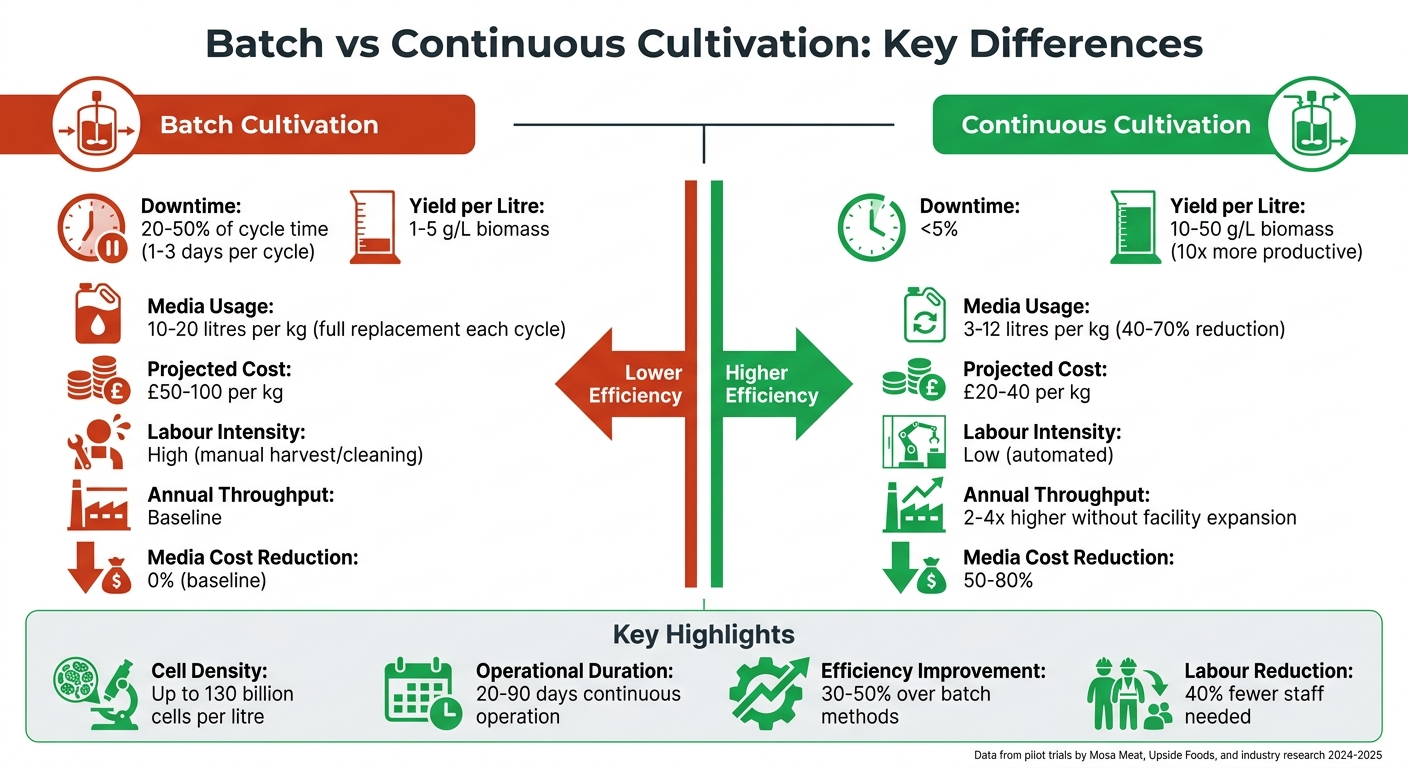
Batch vs Continuous Cultivation: Cost and Efficiency Comparison
Batch cultivation operates in cycles, requiring complete use of the media and experiencing downtime of 20–50% for cleaning and resetting between cycles. In contrast, continuous cultivation introduces fresh media and removes waste in real time, allowing for nearly uninterrupted operation. For batch systems, this downtime typically spans 1–3 days per cycle [6][8].
When it comes to yield per litre, continuous systems outperform batch methods significantly. Batch systems usually produce 1–5 grams of biomass per litre due to nutrient depletion and cell stress. Meanwhile, continuous systems maintain optimal growth conditions, achieving yields of 10–50 grams per litre - up to ten times greater productivity [3][5].
Media usage is another area where the two methods diverge. Batch cultivation requires a full media replacement for each cycle, consuming approximately 10–20 litres per kilogram of meat produced. Continuous cultivation uses perfusion techniques to recycle media, reducing consumption by 40–70%. This translates to lower costs, with batch systems incurring media expenses of roughly £50–100 per kilogram compared to £20–40 per kilogram for continuous systems [4][7].
Advantages of Continuous Cultivation Over Batch Processing
The near-zero downtime of continuous cultivation - compared to 20–50% for batch systems - can increase annual throughput by 2–4 times without needing to expand facilities [6][8]. This efficiency is particularly valuable for large-scale UK operations targeting production volumes of around 1,000 tonnes annually, as it helps minimise capital costs. Pilot trials by companies like Mosa Meat have shown efficiency improvements of 30–50% when shifting from batch to continuous methods [5][6].
Continuous cultivation also reduces labour demands by automating harvesting and cleaning tasks, cutting labour requirements by around 40% [3][6]. Additionally, resource efficiency improves due to reduced media waste and the ability to maintain consistent growth conditions. These benefits are summarised in the comparison table below.
Comparison Table: Batch vs Continuous Cultivation
| Metric | Batch Cultivation | Continuous Cultivation |
|---|---|---|
| Media Usage | 10–20 litres per kg (full replacement) | ~3–12 litres per kg (≈40–70% reduction) |
| Yield per Litre | 1–5 g/L biomass | 10–50 g/L biomass |
| Downtime | 20–50% of cycle time | <5% |
| Projected Cost | ~£50–100 per kg | ~£20–40 per kg |
| Labour Intensity | High (manual harvest/cleaning) | Low (automated) |
These figures clearly illustrate the operational and cost advantages of continuous cultivation.
In the early days of cultivated meat production, batch methods dominated. For example, Upside Foods' initial chicken trials yielded about 2 grams per litre with high media costs [3][6]. However, by adopting continuous systems in 2024, yields increased to approximately 15 grams per litre, with costs dropping by around 60% [3][6]. Similarly, Aleph Farms has made strides with perfusion systems running for week-long durations, offering valuable lessons for scaling up cultivated meat production efficiently in the UK.
Cost Advantages of Continuous Cultivation
Reducing Media Costs and Improving Yields
In the production of cultivated meat, media costs are a major expense, accounting for 55–95% of total costs in early-stage processes. This is largely due to the high volumes and precise formulations required to sustain cell growth.
Continuous cultivation directly addresses this issue by employing perfusion systems. These systems continuously refresh the media and remove waste, leading to better nutrient efficiency and recycling of key components. This approach can reduce media expenses by 50–80% compared to traditional batch methods. For instance, Upside Foods has demonstrated that continuous bioprocessing can cut media use by 70% while significantly increasing yields. Similarly, Mosa Meat has reported a reduction in media costs from £50/kg to under £10/kg during lab-scale trials using perfusion systems.
By maintaining optimal growth conditions over extended periods, continuous cultivation achieves cell densities exceeding 10⁸ cells/mL, which is 5–10 times higher than batch methods. This allows fixed costs like labour and equipment to be spread across a larger output. At scale, media costs could drop to less than 20% of total production, making the process far more cost-efficient.
In addition to media savings, continuous cultivation reduces operational complexity and capital demands.
Labour and Capital Efficiency
Continuous systems not only save on media costs but also improve overall production efficiency through automation. With sensors and pumps managing feeding, harvesting, and monitoring, manual intervention drops from daily to weekly, reducing labour needs by 40–60%. This shift allows operators to focus on optimising processes rather than routine tasks, a crucial advantage for facilities aiming for commercial-scale output.
Capital efficiency also benefits significantly. Automation increases bioreactor uptime from 50% to 80–90%, reducing the number of tanks required to achieve the same production levels. For large-scale facilities targeting 10,000 tonnes per year, this could result in capital expenditure savings of 30–50%. These improvements make continuous systems a practical choice for scaling production while keeping costs manageable.
Scaling Up for Cost Reductions
The modular design of continuous cultivation systems simplifies scaling. Producers can expand capacity by adding bioreactors without overhauling their processes. This scalability is vital for achieving economies of scale. According to experts at the Good Food Institute, continuous cultivation could bring the cost of cultivated meat down to £4–6/kg by 2030, aligning with the price of UK beef mince. This would be achieved through 10x yield improvements and 50% media cost reductions at scale.
A 2024 study from UC Davis supports these projections, suggesting that price parity could be reached with 50,000-litre bioreactors operating continuously. Scaling further to 100,000 tonnes per year could drop costs from today’s £100/kg to under £5/kg, as fixed expenses are distributed across higher production volumes.
These advancements are key to making cultivated meat more affordable and competitive in the long term.
Challenges and Limitations of Continuous Cultivation
While continuous cultivation offers cost advantages, it also comes with several operational challenges that can't be overlooked.
Contamination Risks and Cell Line Stability
One of the biggest risks in continuous cultivation is contamination. Unlike batch processes, which reset after each cycle, continuous systems operate non-stop for weeks or even months. This prolonged operation increases the chance of contamination, as a single breach can allow microbes to spread unchecked, wiping out entire cultures. In fact, contamination is responsible for 20–30% of production losses in pharmaceutical biomanufacturing[3][6][9]. To combat this, strategies like real-time monitoring, multi-barrier sterilisation, and closed-loop single-use bioreactors are often employed. However, these solutions come with added complexity and cost. Automation has shown promise, reducing contamination risks linked to human error by up to 50% at pilot scale, but it doesn’t eliminate the issue entirely[3][10].
Another challenge is maintaining cell line stability. Over time, cells in continuous systems are prone to genetic drift, mutations, and changes in phenotype. These shifts can slow proliferation or alter protein expression, jeopardising product consistency. Studies show that cell lines can lose 10–20% viability per month without proper optimisation[5][7]. Continuous systems also expose cells to steady nutrient flows and shear stress, which can accelerate genetic instability. To maintain productivity, frequent re-seeding or genetic engineering is often required - both of which add to operational complexity.
These cellular issues are compounded by the technical demands of designing suitable bioreactor designs.
Bioreactor Design and Technical Requirements
On top of cell-level challenges, the engineering side of continuous cultivation poses significant hurdles. Scaling up requires bioreactors that go beyond the capabilities of most current equipment. These systems need to handle continuous media exchange (perfusion), retain high-density cells using technologies like hollow-fibre modules or acoustic separators, and ensure even mixing without causing excessive shear. However, many stirred-tank reactors struggle with volumes exceeding 2,000 litres[6][11].
Technical inefficiencies are another issue. Current systems often face 20–50% cell washout, and the energy demands of mixing can increase operational costs by £0.50–£1.00 per litre of media processed[6][9]. For example, in stem cell expansion for therapeutic applications, continuous perfusion bioreactors have only achieved 70–80% efficiency due to problems like fouling and uneven cell distribution. These same obstacles are likely to affect cultivated meat production as well[5][11]. Additionally, operating such systems requires highly specialised bioprocess engineering skills and advanced sensor integration - both of which are in short supply[3][9].
These challenges highlight the technical and operational barriers that need to be addressed for continuous cultivation to reach its full potential.
Impact of Continuous Cultivation on Future Pricing
Continuous cultivation holds the potential to make cultivated meat an everyday option for consumers. While there are technical hurdles to overcome, the efficiency gains it offers could lead to a significant drop in prices. Here's how this process might shape future pricing.
Projected Price Reductions
In the early days, producing cultivated meat cost upwards of £1,000 per kilogramme, making it inaccessible to most consumers. However, as production scales up over the next 5–10 years, continuous cultivation could bring prices down to as low as £10–£37 per kilogramme[3]. This dramatic reduction - over 90% - could be achieved through improvements like reduced media costs, higher yields, and minimising downtime[5].
Pilot trials are already showing encouraging signs. Companies like Aleph Farms and Mosa Meat have reported cutting media and energy costs by 40–60% through continuous cultivation systems. In one 2025 trial, a continuous setup produced five times the yield of traditional batch processing. At a 10,000-litre scale, costs are projected to drop to about £20 per kilogramme[9]. With annual yield improvements of 20–30%, the industry could reach the £10–£37 per kilogramme range by 2030[3]. These advancements bring cultivated meat closer to competing with conventional meat prices.
Achieving Price Parity with Conventional Meat
For cultivated meat to become a viable alternative, its production costs need to match those of traditional meat. In the UK, conventional beef and chicken retail for approximately £10–£15 and £5–£8 per kilogramme, respectively. Continuous cultivation could eventually lower production costs to £5–£10 per kilogramme at industrial scales of 100,000 litres or more[3]. This would make cultivated meat a competitive option on supermarket shelves.
Achieving price parity involves several challenges. Scaling bioreactor volumes to 20,000 litres or more is essential, but this could take 3–5 years. Regulatory approvals and maintaining cell line stability during extended production runs are also critical factors. While advancements in perfusion technology and improved contamination control could make price parity feasible by 2030, the high costs of bioreactor infrastructure and ongoing issues with cell stability could slow progress if these challenges aren't resolved.
Conclusion
Continuous cultivation is redefining the way Cultivated Meat is produced, making it more cost-effective and accessible. By reducing downtime, making better use of growth media, and increasing production efficiency, this method directly addresses the biggest hurdle to widespread adoption: cost. Current estimates suggest that prices could drop dramatically - from around £25–40 per kilogramme to as low as £8–12 per kilogramme - making Cultivated Meat an everyday option for households across the UK.
Early trials have already shown cost reductions of 30–50% compared to traditional batch processing. These results strengthen the case that Cultivated Meat could soon rival conventional meat in price, bringing it closer to the mainstream market.
The benefits extend beyond just affordability. Continuous cultivation offers a more reliable supply chain, greater product variety, and a stronger case for market acceptance. It demonstrates that Cultivated Meat has the potential to compete not only on price but also on sustainability, making it an attractive option for consumers who value both.
That said, challenges remain. Issues like contamination risks, maintaining stable cell lines, and optimising bioreactor designs still need to be addressed. However, with ongoing investment and technological progress, these hurdles are being steadily tackled. Continuous cultivation is no longer just a concept - it’s actively reshaping how Cultivated Meat is produced and priced.
As this technology evolves, Cultivated Meat Shop remains committed to guiding consumers through these advancements, helping them understand how these innovations make Cultivated Meat a practical and affordable alternative to traditional options. With continuous cultivation driving progress, the industry is well on its way to making Cultivated Meat a sustainable and accessible choice for the future.
FAQs
Will continuous cultivation change the taste or texture of Cultivated Meat?
Continuous cultivation is likely to improve the texture and consistency of cultivated meat, enabling techniques that replicate the chewiness and structure of traditional meat more effectively. That said, early versions might still fall short in capturing some of the richness and juiciness associated with conventional meat.
How do continuous systems keep Cultivated Meat safe from contamination over long runs?
Continuous systems play a crucial role in keeping cultivated meat safe from contamination. They rely on real-time sensors to keep track of factors like pH, oxygen levels, and cell density, enabling automated adjustments as needed. Additionally, they ensure sterile conditions are maintained through automation and rigorous standards such as GMP (Good Manufacturing Practice) and HACCP (Hazard Analysis and Critical Control Points). Together, these measures ensure safety and consistency throughout longer production processes.
What needs to happen for £5–£10/kg cultivated meat to reach UK shops by 2030?
To reach a cost of £5–£10 per kilogram for cultivated meat by 2030, significant progress is needed in several areas. Scaling up bioreactors to handle larger volumes efficiently is crucial. At the same time, reducing production costs will depend on developing more effective systems. Cutting the price of growth factors and culture media is another essential step.
Technologies like synthetic biology, serum-free media, and continuous manufacturing processes will play a major role in achieving these goals. These advancements could help streamline production and make cultivated meat more accessible.