About 60% of South Africans surveyed in 2021 said they were highly likely to try cultivated meat, and 53% said they were highly likely to buy it. My takeaway: treat these figures as interest to test - not sales to expect.
The research points to three things:
- Interest outpaced knowledge: only 16.9% reported high familiarity. This mirrors findings in other consumer attitude studies where curiosity often precedes deep understanding.
- Younger respondents showed more buying interest, while price and information also shaped responses.
- Paying more is a separate question: 30.1% of the full survey sample were highly likely to do so.
A separate experiment tested hypothetical burger choices, not purchases. For anyone planning a launch, I’d focus on clear product information and tests using actual packs and prices. <u>Neither study proves that people will buy - or buy again.</u>
Interest and Familiarity with Cultivated Meat
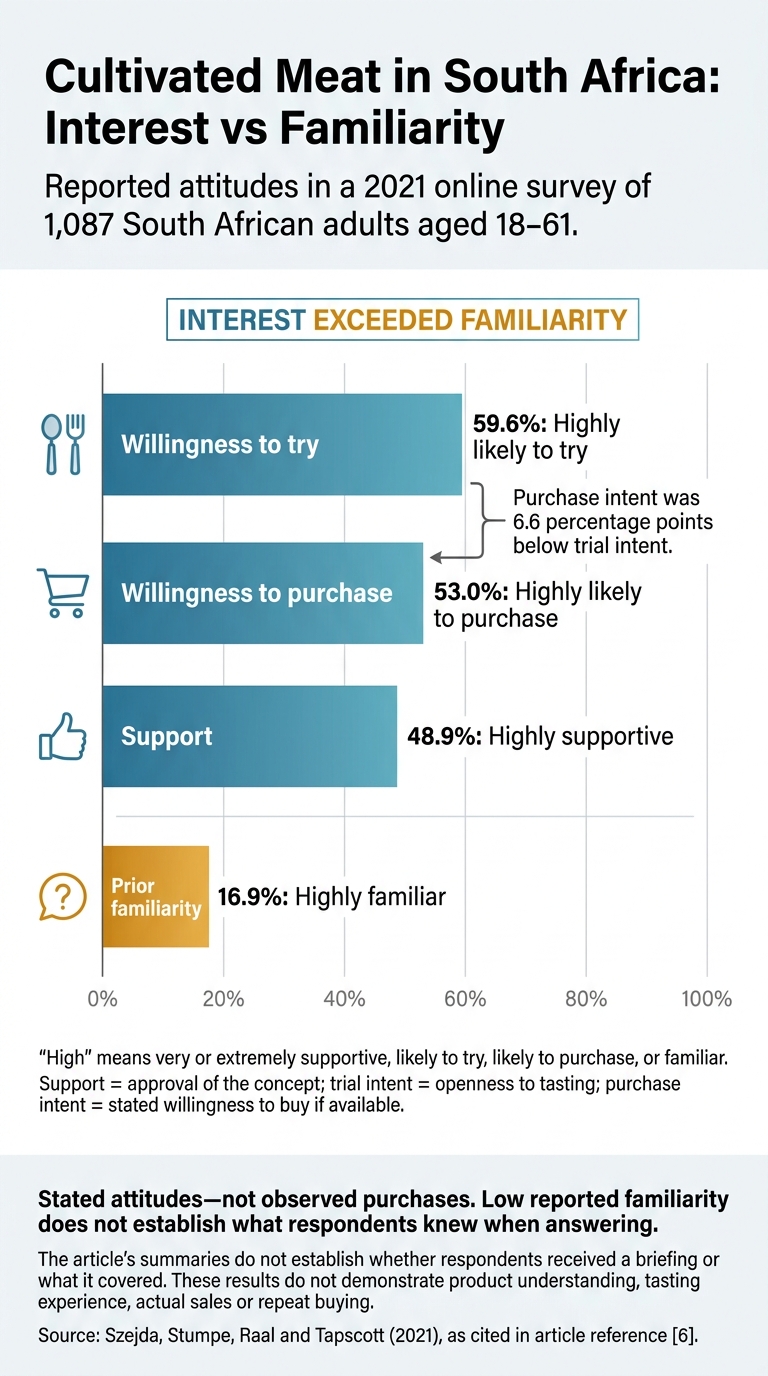
Cultivated Meat in South Africa: Interest vs Familiarity
Support, Willingness to Try and Buy, and Familiarity
Szejda, Stumpe, Raal and Tapscott’s 2021 survey measured four separate attitudes. Interest was much higher than familiarity, but each measure tells a different story.[6]
| Measure | Percentage | Survey response label |
|---|---|---|
| Support for Cultivated Meat | 48.9% | Highly supportive |
| Willingness to try Cultivated Meat | 59.6% | Highly likely to try |
| Willingness to purchase Cultivated Meat | 53.0% | Highly likely to purchase |
| Prior familiarity with Cultivated Meat | 16.9% | Highly familiar |
Here, “high” means very or extremely supportive, likely to try, likely to purchase, or familiar. Support means approval of the concept. Trial intent means openness to tasting it, while purchase intent means willingness to buy it if available.[6]
Purchase intent was 6.6 percentage points below trial intent. Being curious enough to try Cultivated Meat is not the same as wanting to buy it.[6]
Openness Is Not Informed Acceptance
Low familiarity suggests that interest did not necessarily reflect deep knowledge. The summaries do not say whether respondents received a briefing before answering, or what it covered. They therefore cannot show what respondents knew at the time.[6]
The responses also do not establish whether respondents understood how cultivated meat is produced, assessed safety or nutritional profiles or had tasted Cultivated Meat.[6] Launches will need clear explanations of how it is produced, its safety and its nutrition. A willingness to try it does not mean these questions have already been answered.
The next question is which groups were most likely to buy it.
sbb-itb-c323ed3
Who Was More Interested in Buying?
The next question is which groups were most likely to say they would buy it.
Buying Interest by Age and Demographic Group
In the nationwide survey, Born-free respondents and millennials - the two younger cohorts - reported higher buying interest.
| Group | Highly likely to buy Cultivated Meat |
|---|---|
| Born-free respondents | 55% |
| Millennials | 55% |
| Gen X | 46% |
These figures are rounded from 54.7%, 55.3% and 46.3%, respectively.[2][6] Born-free respondents generally means South Africans born after 1994.[1]
A separate choice experiment used different age bands: under 28, 28–41 and 42–61. Its results should not be mapped directly on to the survey groups.[1][3] Among its 649 participants, younger and Black respondents showed relatively stronger preferences for Cultivated Meat and plant-based patties. Older and White respondents favoured conventional beef.
These were simulated choices, not the stated buying intentions measured by the survey percentages above. The patterns show association, not cause.[1][3][5]
The survey’s segmentation analysis looked more closely at respondents with strong buying interest.
How the Early-Adopter Group Was Defined
The segmentation analysis used the same nationwide survey of 1,087 adults aged 18–61, not a separate sample. Early adopters were respondents with strong purchase intent - not confirmed buyers. They tended to be younger, particularly from the born-free and millennial groups. They were also more likely to be Black, live in a city or town, speak English and/or isiZulu, and be omnivorous.[9]
Price was another part of this profile: 51% of early adopters were highly likely to pay more.[4][9] This gives marketers a clue about whom to target, but it does not prove market demand. For launch planning, it points to outreach in cities and towns, messaging in English and isiZulu, and direct price testing rather than assuming demand from demographics alone.
What Could Influence Buying Decisions?
Once we know who is most interested in buying, the next step is to see how information and price affect that interest. [Taste], health and safety shape expectations, but these are perceptions, not proven product traits. An Eastern Cape study recorded doubts about originality, taste, healthiness and edibility. After hearing how it was produced, 53% said they would eat it.[8] Information about environmental effects also changed willingness-to-pay estimates in the choice experiment.[3] Information can shift interest, but price and taste still matter, as seen in this cultivated vs traditional meat decision guide.
Survey Intentions Compared with Experimental Choices
The survey measured what people said they intended to do. The experiment asked respondents to choose between conventional beef, Cultivated Meat, pea-protein patties, yeast-protein patties and buying nothing, under set price conditions.[3]
| Sample | Measure | Result | Limitation |
|---|---|---|---|
| Choice experiment, 649 consumers | Estimated Cultivated Meat share at equal prices | 38%[3] | Hypothetical choices; depends on the product options and assumed price, not a market forecast |
For the equal-price analysis, all food options cost 125 South African rand per 400 g.[3][10] The 38% applies only to those choosing a food product, not all participants. For launch testing, show shoppers actual pack sizes at several prices rather than relying only on questions about willingness to try.
Who Said They Would Pay More?
Price sensitivity also varies, including within the early-adopter group identified earlier. These respondents expressed strong purchase intent, but they were not confirmed buyers.[9] Strong willingness to pay more and general openness to doing so use different thresholds.
| Sample base | Response category | Reported result | Interpretation and limitation |
|---|---|---|---|
| Early-adopter subgroup | Very or extremely likely to pay more | 51%[9] | Strong stated willingness within this subgroup, not actual spending |
| Early-adopter subgroup | At least somewhat likely to pay more | 94%[9] | A broad category that does not show how much extra people would accept |
Saying they would pay more does not tell us how much extra shoppers would accept - or whether they would still buy Cultivated Meat with a cheaper option available.
Conclusion: What the Findings Mean for Future Launches
The findings suggest there is interest, but launches will succeed only if they reduce uncertainty about price, safety and product form. In the 2021 online survey, 60% were highly likely to try Cultivated Meat and 53% to purchase it. Yet only 16.9% reported high familiarity, and 30.1% were highly likely to pay more.[6][7] These figures point to possible demand - not sales forecasts for any market.
With familiarity low, clear labelling and simple explanations matter.
What Consumers Need to Know Before Buying
Future products need familiar formats and clear labels covering ingredients, allergens, storage, preparation and price. These are practical launch requirements, not claims tested by the South African surveys.
What the Research Cannot Tell Us
Online surveys record stated attitudes, while hypothetical choices examine trade-offs. Neither proves actual purchases, repeat buying or satisfaction.[1][2]
FAQs
How representative are these South African surveys?
These surveys help us understand consumer acceptance and demographic trends, but they may not fully represent the population as a whole [1]. What people say they’ll buy doesn’t always match what they purchase [2]. The findings therefore point to possible interest and attitudes, rather than reliably predicting future buying behaviour [2].
Could tasting Cultivated Meat change buying interest?
Yes. Surveys and trials suggest that tasting Cultivated Meat can increase interest in buying it - provided it offers familiar flavours and a satisfying, meat-like texture. Clear information given alongside samples can also improve acceptance.
UK-wide surveys show that many younger people and men are open to it. But concerns about taste, cost and safety remain, so tastings help most when they address these concerns directly [1][2].
Are the 2021 findings still relevant today?
Yes. The 2021 findings still serve as useful benchmarks, but they should be read alongside newer data. Willingness to try Cultivated Meat rose from 19% in 2012 to 26% in 2024 [1][2]. Acceptance remains higher among younger people and men [1][3][2]. Education and product availability shape consumer views, so earlier studies offer context for tracking progress in the UK market [1][4][5].