Cultivated salmon tastes like mild salmon, but the texture is usually the bigger surprise. If I had to sum it up in one line, I’d say: you get a clean, buttery salmon flavour, with a softer bite and less flake than standard salmon.
Here’s the short version:
- Taste: mild, savoury, clean, and less fishy
- Texture: softer, smoother, and more even
- Smell: lighter and less ocean-like
- Best served: raw, lightly dressed, or smoked
- Closest match: sushi-grade salmon rather than strong wild salmon
- UK status: not on sale in the UK as of 29 June 2026
A few points stand out to me:
- It’s made from real salmon cells
- It tends to be more consistent from portion to portion
- It has no gristle, silverskin, parasites, mercury, or microplastics
- The main trade-off is mouthfeel: it often doesn’t flake like standard fish
Does lab-grown salmon from Bay Area company taste real?
sbb-itb-c323ed3
Quick comparison
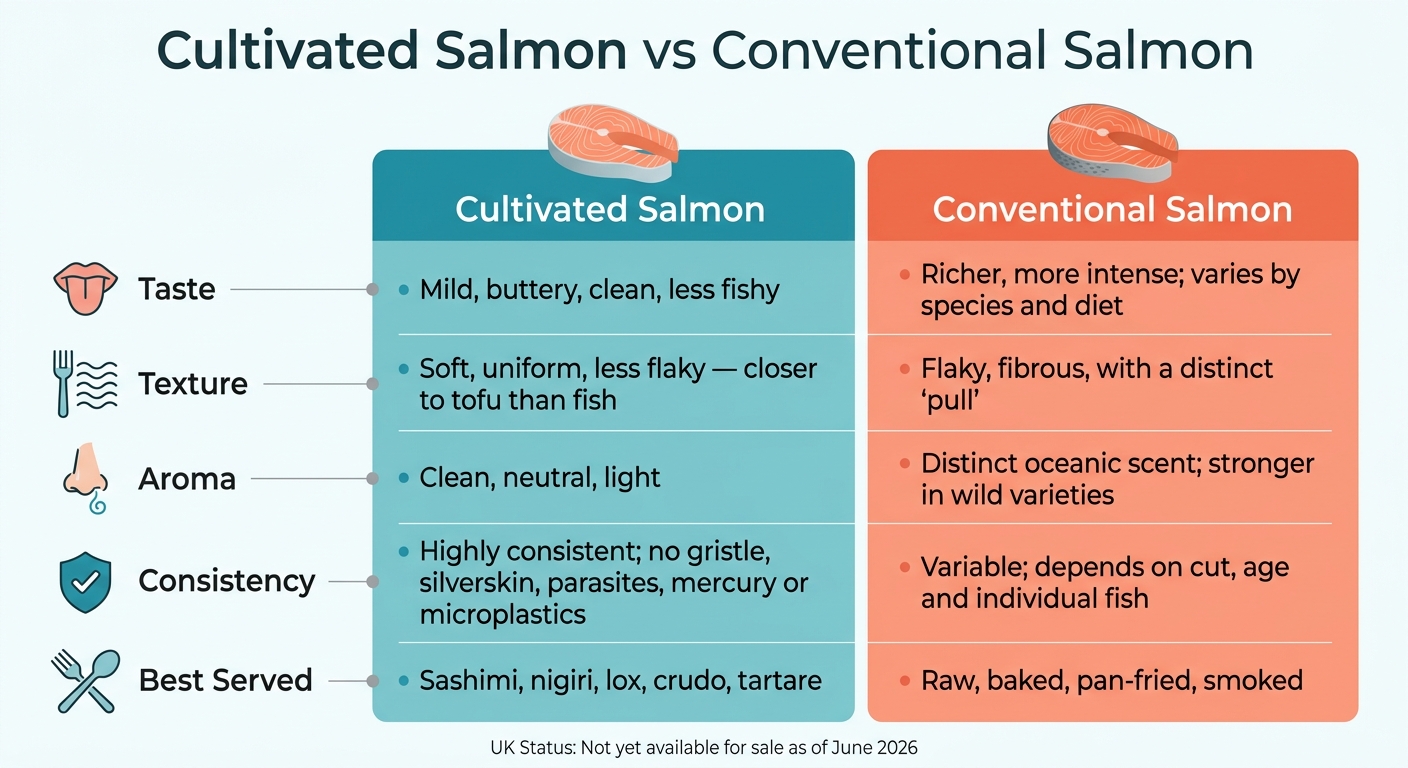
Cultivated Salmon vs Conventional Salmon: Taste, Texture & More
| Feature | Cultivated salmon | Standard salmon |
|---|---|---|
| Taste | Mild, buttery, clean | Often richer and stronger |
| Texture | Soft, even, less flaky | Flaky, fibrous, firmer |
| Aroma | Light and neutral | More sea-like |
| Best formats | Sashimi, nigiri, lox | Raw, baked, pan-fried, smoked |
If you like salmon but don’t want a strong fish taste, this may sound appealing. But While you can check product availability to find these options near you, if you care most about that firm, flaky bite, that’s where you’ll notice the main difference. You can explore various cultivated fish options to see how these innovations are reshaping the seafood market.
How the flavour compares with conventional salmon
Cultivated salmon is closest to mild, sushi-grade salmon. It sits firmly in the clean, mild end of the spectrum, so it feels nearer to a delicate sushi fish than to a strongly flavoured wild salmon.
Mild, savoury and more consistent
The flavour is best described as subtle, buttery and savoury, with far less fishiness than many conventional fillets. Because production is tightly controlled, the taste also stays much more consistent from one serving to the next [4].
Cultivated salmon vs conventional salmon: a side-by-side comparison
| Feature | Cultivated Salmon | Conventional Salmon |
|---|---|---|
| Taste | Mild, subtle, buttery and clean | Richer, more intense; varies by species and diet |
| Texture | Soft, uniform, and less flaky | Flaky, fibrous, with a distinct "pull" |
| Aroma | Clean, neutral, and less fishy | Distinct oceanic scent; stronger in wild varieties |
| Consistency | Highly consistent; no gristle or silverskin | Variable; depends on cut, age and individual fish |
Chefs who have worked with cultivated salmon often say it needs a light touch, especially when high heat is involved. A heavy hand can drown out what makes it stand out in the first place. As Adam H. Callaghan of Food & Wine observed:
"The chefs had to be careful not to overpower the saku's delicate flavor, which is a little more subtle than wild salmon." - Adam H. Callaghan, Food & Wine [1]
That same delicacy also helps explain why texture can leave the stronger impression. In many cases, the bigger contrast shows up in the bite rather than the taste, especially when the salmon is served raw or only lightly handled.
Why texture often makes a bigger impression than flavour
When people try cultivated salmon for the first time, the first thing that tends to stand out is texture. More than flavour, it shapes the way the fish feels in the mouth, and that can leave the bigger impression.
Softer bite and less flake
Cultivated salmon doesn't have the same fibrous structure as conventional salmon. So when you slice it or chew it, you don't get that familiar pull or the clean separation you'd expect from a piece of fish.
Chefs who've worked with it often put it in simple terms:
"It's not like a muscle that's been swimming for years. It cuts more like tofu than a fish." - Renee Erickson, Chef, The Walrus and the Carpenter [2]
Because it has no connective tissue, gristle or silverskin, the bite feels softer and more even. You notice that most when it's eaten raw.
How a softer texture changes the eating experience
That softer texture comes through most clearly in raw or lightly handled dishes. Since texture is the main point of difference, the way it's served matters more than it does with conventional salmon.
In raw preparations - sashimi, crudo or tartare - the texture can feel smooth and buttery, closer to sashimi-style fish. That's why it's often served raw or with very light handling, where that texture is easiest to notice. High heat or torching can work against it instead of helping it.
So the way it's prepared has a big effect on how the fish is experienced at the table, which is why using a cultivated meat recipe generator can help you find the best cooking methods.
How preparation affects the taste
Preparation has a bigger effect on cultivated salmon than many people expect. The flavour is mild, and the texture is soft. So the format often decides how the fish comes across on the plate.
Tasting the flavour directly: raw and lightly handled formats
Sashimi-style cuts or simple nigiri give the clearest sense of flavour and texture. Raw or lightly dressed servings make that mild taste easiest to notice.
Once that base flavour comes through, salt, smoke and acidity can push it in a different direction.
How salt, smoke and acidity affect the taste
Different prep styles change the balance in different ways. Smoked formats, especially lox, are where cultivated salmon often feels most familiar. Smoking and curing work well with its softer structure and help it seem closer to what people already know. Brian Cooley, a technology expert who tried Wildtype's cultivated lox, said:
"You would have to tell someone that the Wildtype lox wasn't conventional for them to suspect it was anything different." [3]
Acidity and crunch can also offset the softer bite. Strong seasonings, though, can drown out the fish altogether.
For UK shoppers, the main point is simple: the best format depends on how they plan to eat it. For those looking to integrate these new proteins, following a sustainable eating checklist can help transition to more ethical choices.
What this means for UK shoppers
For UK shoppers, the main point is pretty simple: the flavour feels familiar, but the softer, more even texture is the thing people are most likely to notice. So when this reaches the table, that texture difference is likely to shape the whole experience.
That mix makes cultivated salmon especially interesting for people who like the taste of salmon but are open to trying it in a new form. It’s likely to speak most to flexitarians and seafood fans, and shoppers looking for a lower-impact option.
Chef Gregory Gourdet, who has served cultivated salmon at his restaurant Kann, said:
"We serve it not only for its quality, but also to spark conversation about declining global fish populations and the critical moment we face in protecting ocean health." [1]
Because it is grown in controlled conditions, cultivated salmon avoids mercury, microplastics and parasites. It can also reduce pressure on wild salmon stocks and cut some pollution linked to fish farming. [1][4]
The other big issue for UK shoppers is availability. It is not yet sold in the UK. That said, the Food Standards Agency (FSA) has launched a sandbox programme to support assessment of Cultivated Meat products. [5]
If you want to keep an eye on new developments, Cultivated Meat Shop has educational guides, waitlist sign-ups and product previews. It does not manufacture or sell cultivated salmon.
FAQs
Can cultivated salmon be cooked like regular salmon?
Not usually. Current cultivated salmon products are mainly made for raw or cold dishes, such as sashimi, crudo, tartare and smoked lox.
That comes down to their structure. Even though they’re designed to mirror the taste, texture and overall eating experience of conventional salmon, they may not handle high heat in the same way as standard salmon.
Why doesn’t cultivated salmon flake like traditional salmon?
Cultivated salmon doesn’t always flake like traditional salmon. It contains real fish tissue, but the structure is still being refined.
That matters because flaking comes from the way muscle fibres and fat form natural layers in fish. In cultivated salmon, those layers may not yet come through in quite the same way.
Some people say the texture feels softer, squishier, or more uniform than the natural layers in traditional salmon. So when you slice it, it may break in a firmer, more rigid way instead of separating into delicate flakes.
When will cultivated salmon be available in the UK?
Cultivated salmon is expected to reach UK supermarkets by 2027.
That said, it’s not on shelves just yet. The sector is still working through regulatory sandboxes and taste trials, including trials taking place in 2025, so broader commercial availability is still being developed.
If you want to follow progress and see when availability changes, Cultivated Meat Shop shares educational content and offers waitlist sign-ups.