Cultivated meat, grown from animal cells in controlled environments, is not yet available in UK supermarkets. Instead, niche stores and online platforms like Cultivated Meat Shop are preparing for its eventual launch. These platforms provide updates on regulatory progress and offer early access once products are approved.
Here’s what you need to know:
- Availability: No cultivated meat for human consumption is approved in the UK yet. However, pet food containing cultivated meat has been available since 2025.
- Challenges: High production costs, regulatory delays, and limited large-scale facilities are major obstacles. Approval for human consumption is expected by late 2026.
- Pricing: Initial products, such as burgers and nuggets, will be costly (£8–10 per portion) due to production expenses but should become more affordable as technology advances.
- Upcoming Products: Ground meat products will appear first, with whole-muscle cuts like steaks following later as production methods improve.
For updates, you can register with platforms like Cultivated Meat Shop to stay informed about product launches and regulatory changes.
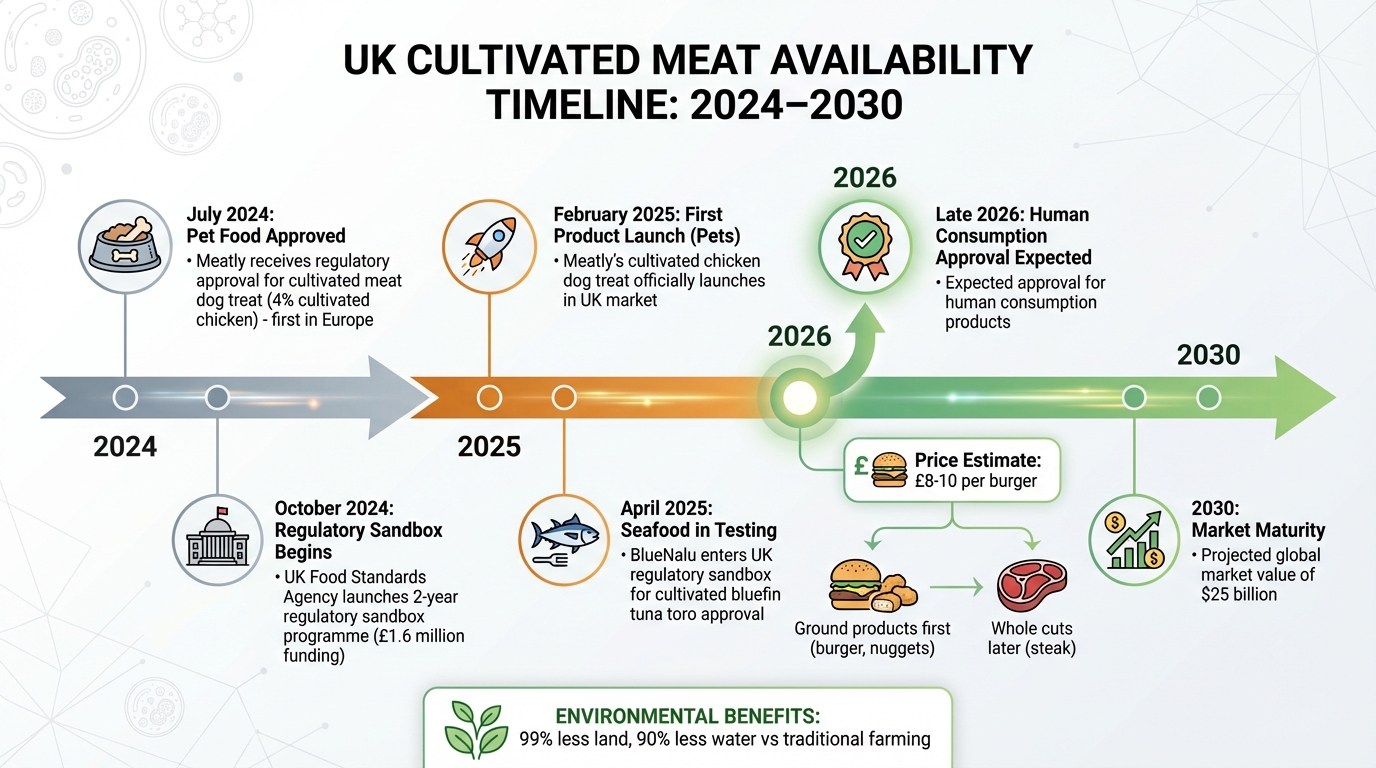
Cultivated Meat UK Timeline: From Pet Food to Human Consumption 2024-2030
Meatly Launching Cultivated Pet Food In The UK This Year?

What Cultivated Meat Products Are Available Now?
At the moment, you won’t find cultivated meat on the shelves of UK supermarkets or even in niche food shops. As of March 2026, the UK Food Standards Agency has yet to approve any cultivated meat products for human consumption [3].
That said, there is one exception - but it’s for pets. In July 2024, Meatly (formerly known as Good Dog Food), a London-based company, became the first in Europe to receive regulatory approval for a cultivated meat product. This was a dog treat containing 4% cultivated chicken, which officially launched in the UK market by February 2025 [3][6].
Globally, cultivated meat has started making its way to select restaurants as part of pilot programmes. For example, in 2020, Singapore offered early cultivated chicken bites at a restaurant for around £13 per portion [5]. Unfortunately, UK consumers will have to wait a bit longer to experience this firsthand.
Why Cultivated Meat Isn't in Stores Yet
There are several hurdles keeping cultivated meat out of UK stores. The UK Food Standards Agency initiated a two-year regulatory "sandbox" programme in October 2024, backed by £1.6 million in funding. While this is a step forward, approvals likely won’t happen until late 2026 [3].
Cost remains a major issue. The liquid culture medium used to grow cells is incredibly expensive, accounting for over 99% of production costs [3]. To put it into perspective, estimates for producing one kilogram of cultivated meat range from £13 to a staggering £320,000 [3].
Another challenge is scaling up production. Most UK-based cultivated meat companies are working with small-scale equipment and lack access to facilities capable of handling large commercial volumes [3]. For comparison, in March 2025, Australian company Vow successfully grew cells in a 20,000-litre bioreactor - a scale far beyond what most UK companies are currently achieving [3].
Public opinion also plays a part. A survey revealed that 46% of UK consumers believe cultivated meat shouldn’t be sold in the country. However, between 16% and 41% of respondents indicated they’d be willing to give it a try [3]. On top of this, concerns from the farming sector about potential impacts on livelihoods add another layer of complexity [3][4].
How to Track Product Availability
Given these challenges, keeping an eye on regulatory updates is key. Since cultivated meat isn’t available yet, platforms like Cultivated Meat Shop can help you stay informed. This site acts as a central hub, offering product previews, educational resources, and notification systems tailored for UK consumers [2].
You can sign up for email alerts on specific product categories - like Cultivated Chicken, Beef, or Fish - so you’ll know the moment regulatory approval is granted [2]. The homepage also features an interactive timeline that tracks regional launch estimates [1][7].
Some companies are already working towards approval. For example, as of April 2025, San Diego-based BlueNalu is participating in the UK’s regulatory sandbox to gain approval for its cultivated bluefin tuna toro. They’ve also partnered with Nomad Foods to strategise their entry into the UK and European markets [6]. Watching the progress of the FSA sandbox through late 2026 will provide a clearer picture of when human-grade products might finally hit the shelves [3].
For real-time updates, Cultivated Meat Shop is a go-to resource:
"As the regulatory landscape evolves and products receive approval, we'll notify you immediately so you can be among the pioneering consumers of this revolutionary food technology." – Cultivated Meat Shop [2]
How Much Does Cultivated Meat Cost?
Current High Prices
At launch, expect to pay around £8–10 for a burger equivalent [1]. This steep price reflects the intensive production process. Unlike traditional livestock farming, growing meat from animal cells in bioreactors demands specialised equipment and infrastructure [1]. A significant factor driving costs is the cell-culture media - this nutrient-rich liquid, essential for feeding the cells, makes up over 80% of production expenses [8]. In these early stages, the lack of large-scale production keeps prices high, with cultivated meat marketed as a premium, sustainable choice in niche outlets [1]. However, as production scales up, costs are anticipated to drop.
Expected Price Drops Over Time
Prices are expected to decrease as production methods evolve and expand. Transitioning from small lab-scale operations to larger bioreactors, along with improved cultivation techniques and industry partnerships, will help bring costs down [1]. Regions like Israel and North America are leading the charge in developing more efficient processes to make cultivated meat a competitive option [1]. Over time, these advancements aim to shift cultivated meat from a luxury product to an everyday food choice for consumers.
sbb-itb-c323ed3
Which Products Will Appear First?
Ground Products: Burgers, Nuggets, and Sausages
The first wave of cultivated meat products hitting niche stores will likely come in ground or minced forms - think burgers, nuggets, and sausages. These products are easier to produce because they don’t need the intricate 3D scaffolding required to mimic the muscle fibres and connective tissues found in whole cuts [1][7]. With production cycles typically ranging from 2 to 8 weeks [11], these items are quicker and more economical to manufacture.
"the first available products are likely to be fairly 'unstructured', such as mince, nuggets and hamburgers." - FoodUnfolded [11]
Initial offerings will include cultivated chicken, beef, lamb, pork, and seafood [1][7], presented in forms familiar to home cooking. A milestone for the industry came in December 2020, when Eat Just made the world’s first commercial sale of cultivated meat - unstructured chicken bites - in Singapore [10][11]. Beyond human consumption, some pet food products are also gaining regulatory traction. As techniques improve, these early products will pave the way for more structured options like whole-muscle cuts.
Whole-Muscle Cuts Coming Later
While ground products dominate the early market, whole-muscle cuts like steaks and chicken breasts are on the horizon. Replicating the texture and complexity of these cuts is one of the industry’s toughest challenges [1][7]. Advanced tissue engineering is required to recreate the extracellular matrix, ensure nutrient flow through vascularisation in thicker tissues, and achieve precise fat marbling. As a stepping stone, many companies are focusing on "semi-structured" products, such as thin-cut steaks or stew meats, before attempting fully structured cuts [12].
"The earliest cultivated meat products on the market are likely to fall mainly on the unstructured end of the spectrum. As the technology improves, it will become possible gradually to replicate more structured and complex products." - GFI [12]
As production methods evolve, the market is expected to shift gradually from minced options to more sophisticated cuts. However, this progression will depend heavily on technological advancements and regulatory green lights.
How to Prepare for Buying Cultivated Meat
Sign Up for Early Access
If you're eager to try cultivated meat, the first step is to register your interest. Platforms like Cultivated Meat Shop allow you to sign up for updates on specific categories - whether you're interested in cultivated chicken, beef, seafood, or even exotic options. By doing this, you'll receive alerts as soon as these products gain regulatory approval and become available in your area [2].
Look out for tools like interactive timeline checkers and region-specific websites (e.g., those ending in .co.uk) to get updates tailored to your location. Joining waitlists for your preferred products can even give you priority for pre-orders and early releases [1][9]. This way, you’ll only receive information about the products you care about, avoiding unnecessary notifications.
How to Read Product Labels
When you're ready to buy, understanding product labels is key. Look for an oval mark with "UK" or "GB" to confirm the product was made in an approved facility that adheres to food safety and hygiene standards [15]. Labels should also clearly state the production method, using phrases like "derived from animal cell-cultured technology" in text as prominent as the product name [13].
"Labeling should clearly and unequivocally communicate the product is derived from animal cell-cultured technology in text the same size and visibility as the product name on the actual package - not hidden on a website link." – A Greener World [13]
Additionally, check for details about the species origin (e.g., "derived from beef cells") and review the full list of ingredients, including any growth media or additives used in production [13]. This is especially important for those with meat allergies, as cultivated meat contains the same allergens as traditional meat [13][14]. Be wary of claims like "organic" or "humane" on these products - since no animals are raised, such terms can be misleading [13]. Lastly, if the product contains over 5% water, the label must include "added water" in its name [14].
What to Expect Going Forward
Cultivated meat is steadily moving from concept to reality, with notable progress in regulatory approvals, scaling efforts, and market entry. While these products aren't yet available in mainstream supermarkets, the foundation is being laid. For example, in 2026, the UK saw Mosa Meat submit an application to the Food Standards Agency's regulatory sandbox for approval of cultivated fat, and Australia gave the green light for Vow's cultivated Japanese quail to be served in restaurants [17].
This regulatory progress suggests that initial products will soon become available. Ground meat products - like burgers, nuggets, and sausages - are expected to be the first to hit the market, with more intricate whole-muscle cuts arriving later in specialty stores. Early cost assessments indicate that cultivated meat is on track to become economically viable, with forecasts pointing to a $25 billion global market by 2030 [18].
The journey has already started with approvals for cultivated pet food and trials in restaurants. In the UK, cultivated meat for pet food is likely to appear first, setting the stage for eventual human consumption [16][17]. Globally, restaurant testing is expanding, giving brands a chance to refine their offerings and gather feedback before moving into retail.
If you're eager to stay ahead, you can sign up with Cultivated Meat Shop for updates on product approvals and launches [20]. Keep an eye on announcements from the Food Standards Agency and other reliable sources to know when products become available in your area. This isn't just about new items on the shelves - it's a major shift in how meat is produced, using up to 99% less land and 90% less water compared to conventional farming methods [20].
While cultivated meat won't replace traditional options overnight, its gradual entry into the market offers a promising alternative for those prioritising animal welfare and environmental concerns [16][19]. Stay informed, learn to identify these products, and connect with communities shaping this emerging industry.
FAQs
When will Cultivated Meat be legal to buy in the UK?
Cultivated meat is anticipated to hit UK markets around 2027. The Food Standards Agency (FSA) is actively working alongside companies to carry out thorough safety evaluations, aiming to secure necessary approvals by this timeline. Keep an eye on developments in this evolving food sector.
Why is cultivated meat so expensive at first?
Cultivated meat comes with a hefty price tag at first, mainly due to the steep costs of cell culture media, the need for specialised facilities, and the absence of large-scale production methods. However, as the industry expands and production scales up, these costs are anticipated to drop considerably over time.
How can I identify Cultivated Meat on UK food labels?
Look out for the term “cultivated” on UK food labels. It often appears alongside certifications such as the C-Label, HACCP, ISO 22000, or approval from the UK’s FSA. These labels signal that the product meets recognised safety and ethical standards.