When you bite into cultivated meat, you expect the same flavour and texture every time. Solving consistency issues in production isn't just luck - it's the result of stable cell lines. Here's why they matter:
- Consistent Quality: Stable cell lines ensure cultivated meat tastes the same across batches by maintaining genetic and functional traits.
- Reliable Production: They prevent issues like genetic drift and mutations, which can affect taste, texture, or nutritional value.
- Scaling Up: Stability is critical for mass production, allowing cells to grow and differentiate reliably, even after hundreds of cycles.
- Regulatory Approval: Stable processes meet safety and quality standards demanded by agencies like the FDA.
Stable cell lines are the backbone of cultivated meat, ensuring every product meets expectations for flavour, texture, and safety.
Engineering Cell Lines for Cultured Meat and Sustainable Cellular Agriculture #culturedmeat
sbb-itb-c323ed3
What Is Cell Line Stability?
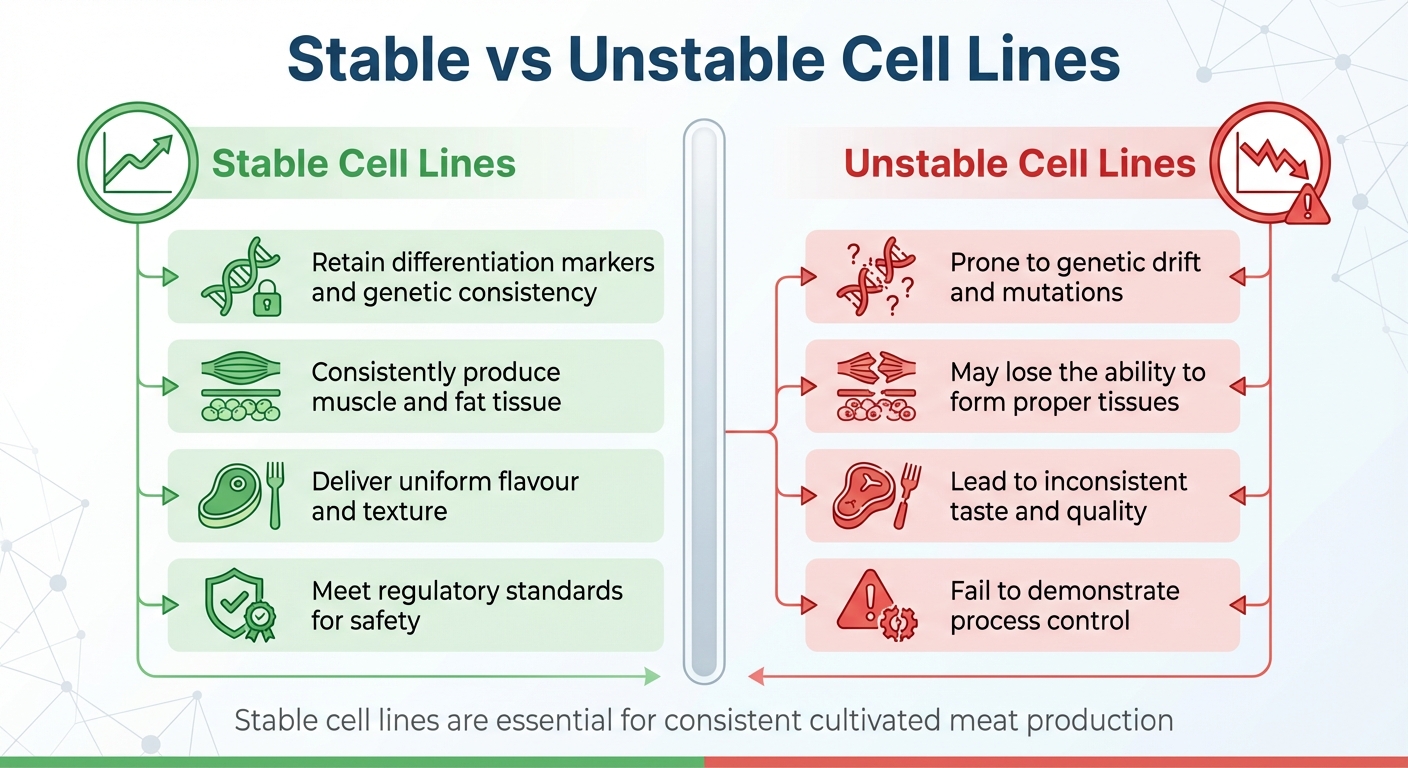
Stable vs Unstable Cell Lines in Cultivated Meat Production
Defining Stable Cell Lines
In the world of Cultivated Meat production, cell line stability refers to maintaining cell populations that consistently exhibit the same genetic and functional traits over time. This ensures that every batch delivers the same quality of meat[2].
Think of it like following a trusted recipe. Stable cell lines retain their ability to differentiate with minimal genetic changes, even after countless cell divisions[3][4]. This reliability allows producers to scale production from a small group of 100,000 cells to the billions - sometimes trillions - needed for manufacturing[3][5].
"You are able to optimize and characterize the cells exactly how you want, so that they also are more stable and durable with less genetic drift and fewer natural mutations than a natural cell line may have." – Andrew Sayles, Co-Founder, Livestock Labs[2]
A key feature of stable cell lines is minimal genetic drift, meaning they resist accumulating mutations or changes that could affect their behaviour. This genetic consistency is what separates dependable production cells from unstable ones that might lose the ability to produce proper muscle or fat tissue[2].
This level of consistency is essential for scaling up production, as explained in the next section.
Why Stability Matters for Production
Without stability, Cultivated Meat production would be as unpredictable as traditional farming. Unstable cell lines could lose the markers needed for differentiation, making it impossible to produce the proteins and fats that ensure consistent flavour, texture, and quality[2][3].
This challenge becomes even greater when scaling production. To achieve commercial quantities, cells must undergo repeated doublings - often more than 100 times for stem cell selection for immortalised lines[4]. If the cells become unstable during this process, the final product might vary significantly in taste, texture, and nutritional value.
Regulatory agencies like the FDA and EMA demand proof that cell lines are genetically stable and that production processes are controlled. For example, in November 2022, Upside Foods received a "No Questions" letter from the FDA for its cultivated chicken. This approval required demonstrating the safety and stability of its cell lines throughout the production process[5][6]. Such regulatory oversight highlights that stability isn't just a nice-to-have - it's a non-negotiable requirement for bringing Cultivated Meat to market.
| Stable Cell Lines | Unstable Cell Lines |
|---|---|
| Retain differentiation markers and genetic consistency | Prone to genetic drift and mutations |
| Consistently produce muscle and fat tissue | May lose the ability to form proper tissues |
| Deliver uniform flavour and texture | Lead to inconsistent taste and quality |
| Meet regulatory standards for safety | Fail to demonstrate process control |
How Stable Cell Lines Create Consistent Taste
Stable cell lines play a crucial role in maintaining both the structural and flavour consistency of Cultivated Meat. They ensure that production processes align with sensory expectations, delivering a product that meets the desired taste and texture.
Consistent Production of Muscle, Fat, and Tissue
The uniform production of muscle, fat, and connective tissue is essential for the taste and texture of meat, whether it's conventional or Cultivated Meat. These components work together to create the familiar bite and mouthfeel people expect.
Muscle production relies heavily on myosatellite cells. These cells differentiate into myoblasts, which eventually form myotubes and myofibres. These structures build the protein framework, giving meat its characteristic texture. For instance, in mice, there are approximately 550 satellite cells per milligram of muscle tissue[1].
When it comes to fat production, fibroadipogenic progenitor (FAP) cells and mesenchymal stem cells (MSCs) are key players. These cells can be directed to produce fatty acid profiles similar to animal subcutaneous fat. In a 2022 study, Dohmen et al. demonstrated that bovine FAP cells, after 28 days of differentiation, produced cultivated fat with a fatty acid profile nearly identical to conventional bovine subcutaneous fat[1].
Fibroblasts contribute by secreting extracellular matrix proteins, which enhance the firmness and structural integrity of the meat. A 2023 study by Cheng et al. highlighted how co-differentiating porcine preadipocyte lines with porcine satellite cells resulted in a "marbled" Cultivated Meat prototype. This prototype replicated the natural fat–muscle patterns found in conventional steak without the need for additional assembly steps[1].
These structural elements not only ensure consistency in texture but also act as the foundation for flavour development, linking the production process to sensory quality and taste.
How Flavour Compounds Develop
The uniform production of muscle and fat is vital for creating optimal flavour during cooking. Muscle proteins and fat-derived lipids are more than just structural components - they serve as the building blocks for flavour development through the Maillard reaction. This reaction, which occurs during cooking, is responsible for the rich, savoury notes associated with meat.
Stable cell lines allow producers to fine-tune these flavour profiles with precision. For example, researchers found that chicken satellite cells cultured at 41°C produced a stronger umami flavour compared to cells grown at slightly different temperatures. This precise control means producers can select and preserve specific cell lines that enhance flavour while also maintaining efficient production processes[1].
Methods for Maintaining Cell Line Stability
Ensuring stable cell lines is essential for maintaining the consistent taste and texture of cultivated meat. Producers rely on three main techniques to safeguard cell quality and reliability while scaling up production.
Cell Banking Systems
Cell banking forms the backbone of consistent production. This involves freezing animal cells in hundreds or even thousands of small vials, which are later used as starting material for production runs. The system is built on two levels: the Master Cell Bank (MCB), which contains the original, carefully characterised cells, and the Working Cell Bank (WCB), derived from the MCB for routine use in production[7].
"This step is called cell banking and involves storing many hundreds or thousands of small tubes containing cells which can then be thawed to start the production process of cultivated meat." - Bernhard Strauss, Britta Kleinsorge, and Pantea Lotfian[7]
By freezing cells in this way, producers prevent unwanted genetic changes that could compromise taste and texture. A vial thawed today will produce the same proteins and fats as one thawed months later, ensuring consistent taste profiles across batches[7].
Selecting the Right Stem Cells
Choosing the appropriate stem cells is crucial for balancing production efficiency and quality. Producers can opt for pluripotent stem cells (like ESCs and iPSCs) or adult stem cells (such as MSCs and satellite cells). Each has its strengths and challenges:
- Pluripotent cells, which include embryonic and induced pluripotent stem cells, are highly versatile and divide quickly - mouse embryonic stem cells, for instance, can double every 4 to 5 hours. However, they require complex protocols to differentiate into specific tissues like muscle or fat[4].
- Adult stem cells, such as mesenchymal and satellite cells, are naturally predisposed to form muscle or fat, making them easier to work with. However, they divide more slowly and are not inherently immortal[1].
Finding cell lines with the right balance of growth speed and differentiation reliability remains a significant challenge for producers. These decisions are critical for achieving consistent flavour and scalable production.
Immortalisation and Genetic Modification
Immortalisation techniques enable primary cells to divide indefinitely, reducing the need for repeated animal biopsies. For example, researchers have successfully immortalised bovine satellite cells by introducing telomerase reverse transcriptase (TERT) and CDK4. This allows the cells to continue growing while retaining their ability to form muscle tissue[1]. Industry benchmarks require immortalised cells to undergo at least 100 doublings without losing their stem cell properties[4].
Genetic modification further supports production by enabling cells to grow in serum-free media and controlling their differentiation into muscle or fat. These modifications directly influence the final product's flavour and nutritional composition[1][4]. Rigorous quality checks ensure the cells maintain their desired traits[7].
Together, these methods preserve cell integrity and help deliver the consistent taste and texture that consumers expect from cultivated meat.
Benefits for Consumers and Producers
Stable cell lines are transforming the landscape for Cultivated Meat, offering advantages that touch every part of the journey - from production facilities to the dinner plate.
Predictable Taste and Texture
One of the standout benefits of genetic stability is the ability to deliver consistent flavour, nutrition, and quality in every batch of Cultivated Meat. This reliability is crucial because taste and texture are often the deciding factors when people choose meat products. When consumers know they can expect the same experience every time, it builds trust and encourages market growth.
In December 2022, researchers linked to Believer Meats published findings in Nature Food that highlighted the spontaneous immortalisation of chicken fibroblasts. These stable cell lines were used to create chicken strips, which scored an impressive 4.5 out of 5.0 in sensory evaluations. Even more compelling, 85% of participants said they were "extremely likely" to swap their regular chicken for the cultivated version[11].
"Cultivated meat cell lines should be genetically stable, in order to ensure consistency in downstream processes and final products and retain differentiation capacity even after a lengthy proliferation phase."
- Camilo Riquelme-Guzmán, Andrew J Stout, David L Kaplan, and Joshua E Flack[8]
Stable cell lines also minimise the risk of off-flavour precursors, ensuring no unwanted surprises in the taste department[8].
Supporting Scalability and Lower Costs
The value of consistency goes beyond taste - it plays a key role in scaling up production and cutting costs.
Genetically stable cell lines make large-scale production feasible, which is essential for making Cultivated Meat more accessible. For example, stable chicken cell lines have achieved densities of 10⁸ × 10⁶ cells per millilitre in continuous culture, yielding 36% w/v[11]. This level of efficiency is a game-changer for commercial production, ensuring both quality and affordability.
Looking ahead, Livestock Labs plans to launch 24 pre-optimised cell lines for cows, pigs, chickens, and sheep by January 2026. These ready-to-use materials will save producers months of work - eliminating the need to extract and characterise new tissue samples, a process that can take anywhere from 6 to 18 months[9][2].
"Creating cell lines is capital efficient. All you really need is a small team to service the industry. You do not need CapEx with the bioreactors or the hundreds of thousands of litres of media."
- Andrew Sayles, Co-Founder, Livestock Labs[2]
Efficiency gains in production are also driving down costs. For instance, optimised processes could bring cell culture media costs to under £0.19 per litre - a staggering 99.9% drop from pharmaceutical-grade prices[9]. Some companies have already reported achieving costs as low as £0.15 per litre. These savings pave the way for Cultivated Meat to compete with conventional meat in terms of price.
Experts predict that by 2040, cell culture technology could account for up to 35% of global meat production[10].
Conclusion
Stable cell lines are the foundation for producing consistent, high-quality Cultivated Meat. They play a crucial role in ensuring predictable flavour, efficient bioprocessing, and cost-effective, large-scale production - all of which influence the final product on your plate[1].
As the field progresses, access to stable cell lines has become more straightforward. Recent advancements now offer ready-to-use lines for animals like cows, pigs, and sheep, enabling producers to scale up operations more efficiently. This not only helps reduce production costs but also paves the way for making Cultivated Meat more widely available[1].
For consumers, this development translates into reliable taste, texture, and safety. Whether you're intrigued by the science or eager to try Cultivated Meat yourself, understanding the importance of cell line stability sheds light on this exciting food innovation.
At Cultivated Meat Shop, we aim to keep you informed about this cutting-edge industry. While Cultivated Meat products aren’t yet available for purchase in the UK, our platform offers educational resources, previews of upcoming products, and early access opportunities. Sign up to our waitlist and be among the first to experience real meat grown from cells.
The journey towards a future of consistent, high-quality meat starts with stable cell lines - and that future is closer than ever.
FAQs
How do companies test that a cell line stays stable over time?
Companies maintain cell line stability by carefully tracking genetic, epigenetic, and phenotypic traits. This process includes both sensory assessments and machine-based testing to ensure that essential features - such as texture, flavour, and growth patterns - remain consistent over time.
Can cell line changes affect nutrition as well as taste?
Changes in cell lines play a key role in shaping the nutrition and taste of cultivated meat. These variations influence the flavour, texture, and aroma by altering biochemical pathways and the composition of fat cells. This ensures that the final product delivers a consistent quality and sensory experience for consumers.
Does using immortalised cells make cultivated meat less safe?
Using immortalised cells in cultivated meat does not compromise its safety. These cells are carefully developed and maintained under strict safety protocols, including sterile environments and thorough testing. Regulatory authorities like the FSA in the UK and EFSA in Europe rigorously evaluate these products before granting approval, ensuring they meet high safety and quality standards.