Here’s the short answer: quantum computing will not make cultivated meat itself, but it may help companies cut R&D time, trim waste, and improve process control. Right now, though, it is still early work. The hardware is limited, the data problem is hard, and any effect on shop prices is still years away.
If you want the plain-English version, this is it:
- What it could help with: cell-line work, growth-media design, bioreactor designs and settings, and factory planning
- What companies want from it: fewer failed tests, lower R&D spend, and more even product quality
- What the numbers suggest: product development today can cost £38 million to £76 million and take three to five years
- Where the pressure sits: about 40% of development time and spend can go on texture work
- What some forecasts say: quantum tools may cut development by 12 to 18 months and R&D costs by 20% to 30%
- Why that is not settled yet: current machines are noisy, short-lived in operation, and hard to use with large biology datasets
- What this means for price: any drop in shelf price would come later, through lower production costs, not from quantum computing on its own
For me, the key point is simple: this is a research tool story, not a shopper story yet. Even if the science improves, cultivated meat still has to deal with media costs, bioreactor limits, energy use, and UK regulation.
| Question | Short answer |
|---|---|
| Can quantum computing lower costs? | Maybe, by cutting failed tests and improving process design |
| Can it speed up market launch? | Possibly, but not soon |
| Can it improve consistency? | It may help with tighter control in production |
| Is it ready now? | No, it is still at an early stage |
| Will it make cultivated meat cheap on its own? | No |
So if you are reading this as a consumer, I’d treat quantum computing as one possible support tool in cultivated meat development, not the main thing that will decide when these products become common or low-cost.
Will Quantum Computing change Agrifood Systems?
sbb-itb-c323ed3
What Quantum Computing Could Do in Cultivated Meat Research
Cultivated Meat research involves a lot of moving parts, which makes optimisation a strong fit for quantum computing. The main upside is fairly simple: better inputs, tighter control, and less waste from trial-and-error work.
Optimising Bioprocesses With Many Variables at Once
Growing meat from cells means managing several conditions at the same time. That includes cell growth conditions, nutrient concentrations, pH, dissolved oxygen, temperature, feeding schedules, and batch timing. Change one setting, and the rest can shift with it. Classical computers often deal with this by using approximations and repeated testing to sort through the knock-on effects.
One quantum method now being studied is feature mapping. It can help analyse complex data patterns, with the goal of making process design more precise. And that matters, because media costs make up the largest share of Cultivated Meat production expenses [7]. So, finding the lowest-cost nutrient mix for a given cell line is still one of the biggest priorities.
Where the Strongest Use Cases Are
These gains matter most in the parts of production that shape cost and consistency. The clearest near-term uses are:
- cell-line optimisation
- growth-media formulation
- bioreactor control
- factory scheduling [4][5]
These steps are the ones most likely to affect production cost and repeatability, which helps push the industry towards more precise process design.
Recent work has also included quantum-assisted modelling of protein gelation, which gives a sense of where the field may be heading [5][2].
That said, not every process calls for quantum computing. Some jobs still fit existing machine-learning tools better. Quantum computing is more likely to sit alongside conventional machine learning than replace it. For example, contamination detection and image analysis still suit standard tools better [8][6]. So it makes more sense to treat quantum computing as a specialised optimisation tool, not a fix for everything.
Potential Benefits and Current Limits
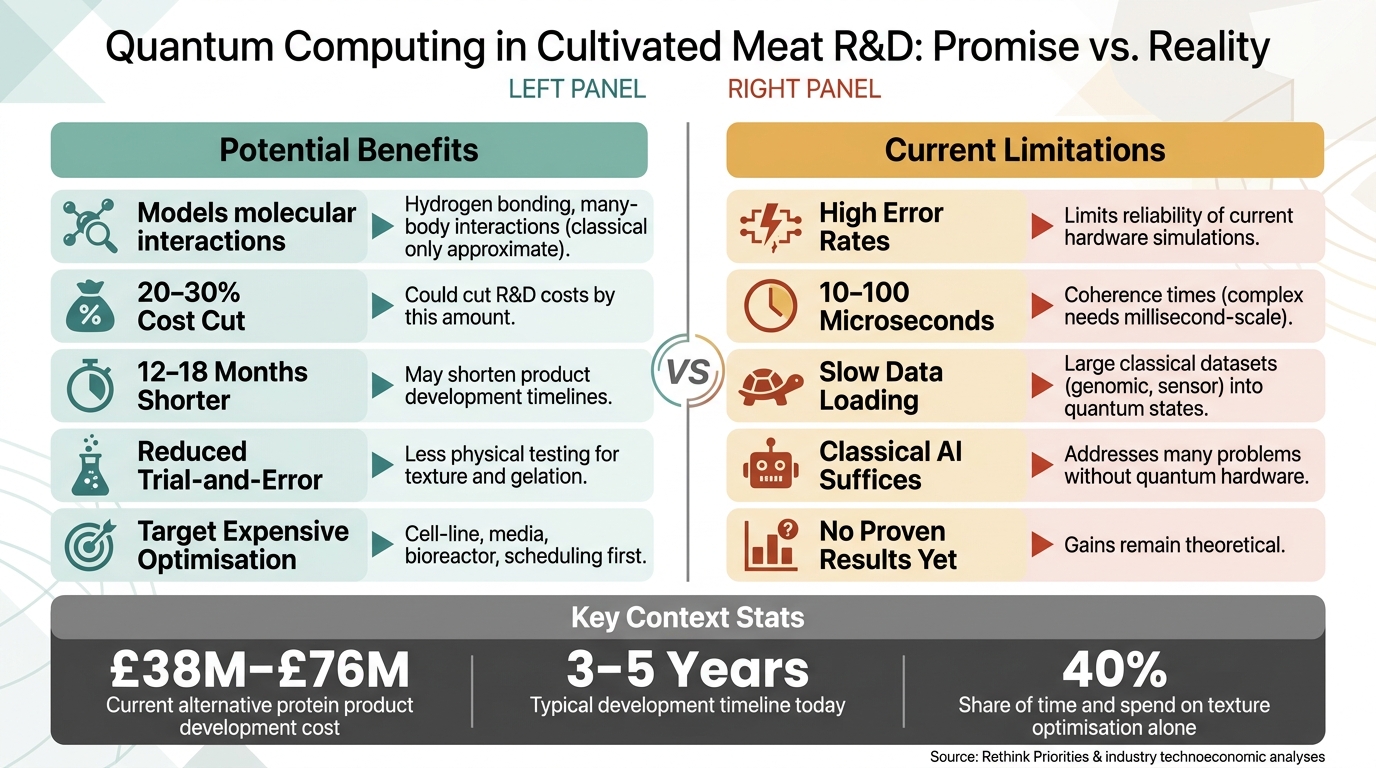
Quantum Computing in Cultivated Meat: Potential Benefits vs. Current Limitations
How It Could Help Cut Costs and Reduce Wasted Experimentation
Quantum computing could cut down on physical testing, sharpen predictions, and bring development costs down. At the moment, alternative protein companies usually spend £38 million to £76 million and three to five years to develop new products [2]. Around 40% of that time and spend goes into texture optimisation alone [2].
That’s where the idea starts to look appealing. Quantum systems could model protein behaviour at the molecular level, including hydrogen bonding and many-body interactions that classical computers can only approximate [2]. In plain terms, that could mean fewer dead-end trials and less money spent guessing.
If these tools become usable in practice, estimates suggest they could shorten product development by 12 to 18 months and cut total R&D costs by 20 to 30% [2]. But that upside only matters if the hardware can deal with the messiness of biological systems outside a lab demo.
Why the Impact Is Still Uncertain Today
Right now, those gains are still more promise than proof. Current quantum hardware is noisy, error-prone, and held back by short coherence times, usually between 10 and 100 microseconds [2][1]. Complex protein simulations may need millisecond-scale circuits, which is beyond what today’s machines can run with much confidence [2]. So for now, the cost savings are still theoretical.
There’s another snag: data loading. Moving large classical datasets, such as sensor data or genomic sequencing data, into a quantum state is slow and computationally expensive [1]. That can wipe out the speed edge quantum processing is meant to deliver.
"Open-access data is the binding constraint. Even as AI systems become more capable, they can only help cultivated meat R&D if sector-specific data exists to train and apply them." - Rethink Priorities Report [9]
Classical AI is already helping with media optimisation and other process tasks without any quantum hardware [9]. So quantum computing will need to do more than sound promising. It has to show a clear edge that justifies the cost and complexity. That matters most if better optimisation can feed through to lower production costs at scale.
| Potential benefits | Current limitations |
|---|---|
| Models molecular interactions classical computers only approximate [2] | High error rates in early-stage hardware limit simulation reliability [1] |
| Could cut R&D costs by 20–30% and shorten timelines by 12–18 months [2] | Coherence times of 10–100 microseconds fall short of what complex simulations need [2] |
| More accurate texture and gelation predictions reduce physical trial-and-error [2] | Loading classical data into quantum states remains slow and inefficient [1] |
| Targets the most expensive optimisation steps first [1][2] | Classical AI can already address many of the same problems without quantum hardware [9] |
For now, hybrid systems look like the most likely route. In that setup, quantum tools would take on only the hardest optimisation jobs, while classical systems handle the rest. The main issue isn’t whether optimisation gets better. It’s whether those gains can reach commercial scale and change price and availability.
What This Could Mean for Price and Availability
How Better Optimisation May Support Lower Future Costs
Building on the optimisation points above, the main issue is simple: do those gains hold up at factory scale and cut the cost per unit?
Quantum computing probably wouldn't lower the price shoppers see on the shelf in any direct way. Its role would come much earlier in the process by cutting waste in research and production.
Right now, the two biggest cost pressures are cell culture media and bioreactor efficiency compared to traditional methods [12]. Quantum models may help teams find cheaper nutrient sources and serum-free formulations faster than older trial-and-error methods [3][12].
The same idea carries over to bioreactors. Scaling production isn't a straight line. As volumes grow, problems around oxygen, heat, and nutrient control start to stack up [10]. Better fluid dynamics modelling could cut down on failed tests and improve cell yields.
For consumer-level affordability, production needs to scale to 20 m³ bioreactors and hit cell densities of about 90 million cells per mL [12].
If these gains build on each other over time, technoeconomic analyses point to a future price floor of £12/kg to £24/kg for Cultivated Meat [12], compared with about £43/kg today [11]. Even then, lower prices still hinge on scale, energy, and regulation.
Why Scale Depends on More Than Quantum Computing
Even if quantum tools help with optimisation, UK availability will still rest on a few very practical limits: bioreactor capacity, input costs, energy prices, and regulatory approval [10][11].
Food-grade bioreactor capacity is still limited [10]. Cultivated Meat production also uses a lot of energy, which means both the cost case and the emissions case depend heavily on access to lower-cost renewable power [10][11]. And in the UK, regulatory approvals add one more layer of uncertainty.
Conclusion: Key Points to Take Away
The main point is straightforward: quantum computing may help researchers model hard production problems, but it does not make the product grow.
That kind of progress still comes down to better hardware, better data, and plain, practical manufacturing gains. In the near term, the most likely progress will come from hybrid approaches, where quantum methods take on the toughest optimisation jobs while classical systems do the rest.
Quantum computing also won’t make regulation and scale barriers disappear. Its effect on price and availability will depend on whether any gains can work at commercial scale.