Fat is key to meat's flavour. It’s not just about juiciness or texture - fat creates the rich taste and aroma we associate with beef, pork, and other meats. When heated, fat releases compounds like aldehydes and furans, which define meat's unique flavour profile.
Cultivated meat, grown from animal cells, faces a challenge: muscle cells provide structure but lack the complex flavour chemistry of fat. That’s where cultivated fat comes in. Researchers are now growing fat cells (adipocytes) to replicate the taste of conventional meat. Studies show cultivated fat closely matches the chemical makeup of traditional fat, including its fatty acids and volatile compounds. It can even be tweaked during production to enhance specific aromas, like buttery or savoury notes.
In sensory tests, cultivated fat performs well, with consumers describing it as "fatty", "fried", and "meaty." Though some off-notes like "musty" remain, ongoing improvements aim to refine the flavour further. Cultivated fat is already being used to improve the taste of hybrid meat products, combining plant proteins with animal cells. By adjusting its composition, it can mimic the flavour and texture of different meats, such as pork or beef.
Key Takeaways:
- Cultivated fat mimics traditional fat in flavour and aroma.
- Fatty acids like oleic and palmitic acid play a major role in creating meaty flavours.
- Sensory tests show cultivated fat is comparable to pork fat, with room for improvement.
- It supports flavour development during cooking, including the Maillard reaction.
- Producers can fine-tune its composition for specific meats or flavour profiles.
Cultivated fat offers a promising way to replicate the taste of meat while reducing reliance on conventional farming.
Dr. Rosalyn Abbott: Adipocyte bioprinting to improve the flavor of cultivated meat products
sbb-itb-c323ed3
How Cultivated Fat Matches Traditional Meat Flavour
Cultivated vs Conventional Pork Fat: Chemical Composition and Sensory Comparison
The real test for cultivated fat lies in how well it replicates the flavour and aroma of conventional meat fat. Recent research highlights that cultivated fat successfully mirrors the chemical and sensory traits that give traditional meat its signature taste.
Chemical Composition of Cultivated Fat
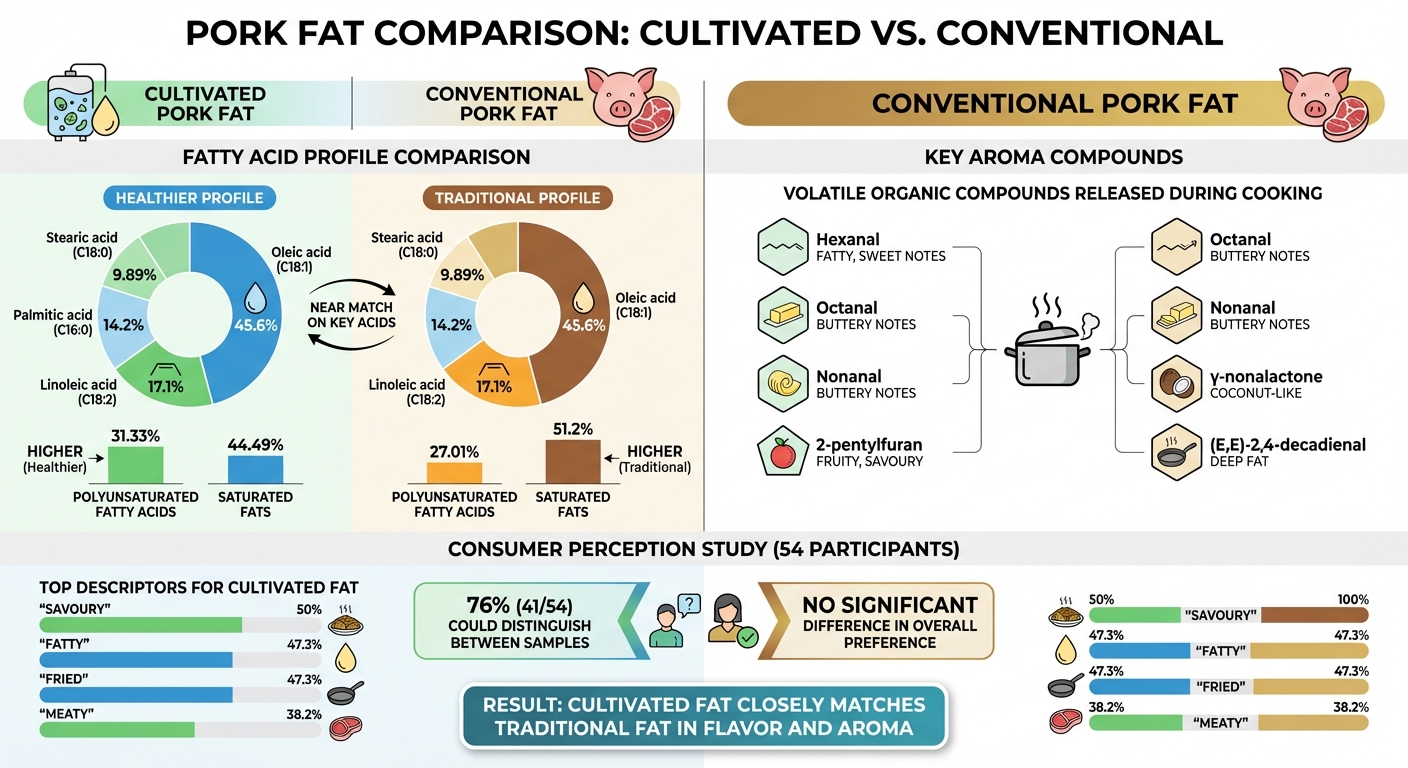
At a molecular level, cultivated porcine fat closely resembles its conventional counterpart. For instance, unmodified cultivated fat contains a fatty acid profile of 45.6% oleic acid (C18:1), 17.1% linoleic acid (C18:2), 14.2% palmitic acid (C16:0), and 9.89% stearic acid (C18:0) - a near match to standard pork fat [2]. These fatty acids are essential for the rich, buttery flavours associated with cooked pork or beef.
When heated, both cultivated and traditional fats release volatile organic compounds (VOCs), which are key to meat's aroma. These include aldehydes like hexanal, octanal, and nonanal, which add fatty, sweet, and buttery notes, as well as furans such as 2-pentylfuran, which lends fruity and savoury undertones.
Interestingly, the flavour profile of cultivated fat can be fine-tuned by altering the culture media. For example:
- Adding thiamine-HCl enhances 4-methyl-5-thiazoleethanol, creating a milky aroma.
- Supplementing with L-methionine increases methional, contributing a savoury, potato-like scent.
- Introducing myoglobin boosts lipid oxidation, enriching compounds like γ-nonalactone (coconut-like) and (E, E)-2,4-decadienal (deep fat) [2].
These chemical similarities lay the groundwork for assessing how cultivated fat performs in sensory evaluations.
Sensory Testing and Consumer Perception
While chemical analysis confirms the likeness, sensory testing provides further evidence of cultivated fat's ability to mimic traditional fat. A study conducted in July 2024 by Tufts University School of Engineering involved 54 participants who compared the aroma of cultivated porcine fat to that of pork belly. In a triangle test, 76% of participants (41 out of 54) successfully distinguished between the two samples [1]. However, hedonic ratings showed no significant difference in overall preference.
In descriptive tasks, participants frequently labelled cultivated pork fat as "fatty" (47.3%), "fried" (47.3%), and "meaty" (38.2%), descriptors commonly associated with traditional meat fat. One study noted that "the volatile profiles generated during the cooking process and fatty aroma characteristics reported by sensory consumers were largely similar between the two fat sources" [1].
However, a challenge remains: some participants noted "musty" or "barnyard" aromas, likely due to higher levels of certain medium-chain fatty acids. Researchers are addressing these off-notes by refining metabolic pathways and optimising culture media. Despite this, the findings are encouraging - cultivated fat is well on its way to delivering the authentic taste and aroma of traditional meat fat, with improvements underway.
The Science Behind Cultivated Fat and Flavour Development
Cultivated fat plays a key role in creating the flavours we associate with meat. Its fatty acid composition and the reactions it undergoes during cooking release the volatile compounds responsible for meat's distinctive taste and aroma. Let’s delve into how fatty acid oxidation and thermal reactions combine to produce these signature flavours.
Fatty Acids and Aroma Compounds
The rich flavour of meat begins with the oxidation of fatty acids. When cultivated fat is heated, fatty acids oxidise, releasing volatile organic compounds (VOCs) that contribute to the aroma of cooked meat. For instance, oleic acid, the most common unsaturated fatty acid in pork fat, and palmitic acid undergo transformations during cooking, producing aldehydes like hexanal and nonanal. These compounds create the fatty, sweet, and buttery notes we associate with meat [5]. Interestingly, the fatty acid profile of cultivated fat can be adjusted based on the nutrients provided during cell growth, reflecting the principle that "cells become what they eat" [6].
In a remarkable example of this precision, researchers at Tufts University, led by Natsu Sugama and David L. Kaplan, demonstrated in October 2025 how targeted nutrient supplementation could fine-tune the fatty acid and aroma compound profile. By adding specific nutrients - 500 μM thiamine-HCl, 5.0 mM L-methionine, and 3.0 mg/mL myoglobin - to porcine fat cells, they successfully generated key aroma compounds like 4-methyl-5-thiazoleethanol, methional, 2-pentylfuran, and (E,E)-2,4-decadienal [2][6][7]. These precise modifications not only replicate the characteristics of traditional fat compared to cultivated alternatives but also optimise the flavour-producing reactions during cooking.
How Cultivated Fat Supports the Maillard Reaction
Beyond oxidation, cultivated fat also contributes to flavour through thermal reactions, particularly the Maillard reaction. This reaction, which occurs between amino acids and reducing sugars, is responsible for the browned, savoury flavours that define cooked meat. Cultivated fat enhances this process by providing oxidation products that interact with Maillard compounds, creating complex aroma molecules like furans, thiophenes, and thiazoles [2].
"Lipid oxidation products, in combination with Maillard compounds, produce a wide variety of aroma compounds in cooked meat." - Natsu Sugama et al., Researchers [2]
This interplay between lipid oxidation and the Maillard reaction highlights the importance of fat content in flavour development. Studies show that beef achieves its best flavour scores when it contains around 36% fat [9]. Fat not only adds richness but also drives the creation of the complex flavours that define a satisfying eating experience. Furthermore, the lipids and phospholipids in cultivated fat - especially those rich in polyunsaturated fatty acids from cell membranes - are highly prone to oxidation. This makes them major contributors to the burst of aroma that occurs when meat is cooked [7][8].
Applications in Cultivated Meat Products
Flavour Improvement in Cultivated Meat
One of the key benefits of cultivated fat is its ability to enhance flavour in meat products, especially in hybrid formulations that mix textured plant proteins with a small percentage of animal cells. Since growing large, structured slabs of meat is biologically challenging due to oxygen and nutrient limitations, researchers focus on cultivating fat cells in flat, 2D layers. These layers are then combined into 3D structures using food-grade binders like alginate or microbial transglutaminase [10].
To further further solve taste challenges, cultivation media are enriched with specific precursors that influence the aroma profile [2][3]. In sensory trials, the introduction of a "bacon-like" aroma in cultivated fat led to a 1.5-point increase in overall liking on a 7-point hedonic scale [1].
When tested with consumers, cultivated pork fat showed promising results - 50% of participants described its aroma as "savoury", while other common descriptors included "fatty", "fried", and "meaty" [1]. In a triangle discrimination test with 54 participants, 41 were able to distinguish between cultivated and conventional pork fat. However, the overall liking scores for both types remained similar [1]. These findings highlight how cultivated fat can effectively replicate traditional meat flavours, offering a precise approach to flavour enhancement.
Adapting Fat for Different Meat Types
Beyond improving flavour, manufacturers are also tailoring cultivated fat to suit the texture and taste expectations of different meat types. The choice of binding agents plays a significant role in this customisation. For instance, sodium alginate creates a texture akin to the fat found in livestock and poultry, while microbial transglutaminase results in a consistency closer to rendered fats like lard or tallow [10].
Adjusting the nutrient composition of the fat allows manufacturers to mimic the fatty acid profiles of specific meats, such as beef, pork, or chicken. For example, cultivated pork fat typically contains 45.6% oleic acid, 17.1% linoleic acid, 14.2% palmitic acid, and 9.89% stearic acid [2]. These precise adjustments to texture and fatty acid composition ensure the cultivated fat aligns with the flavour and mouthfeel of its traditional counterpart, delivering the authentic experience that consumers expect from conventional meat.
Conclusion
Cultivated fat brings the rich and familiar taste of traditional meat to the table. Research shows that cultivated porcine fat closely matches conventional pork fat in terms of volatile compounds and fatty acid composition, ensuring the same depth of flavour consumers expect [1]. In taste tests, participants rated cultivated fat on par with its conventional counterpart, highlighting its ability to replicate the sensory experience of traditional meat.
Flavour can also be fine-tuned through culture media supplementation. By adding compounds like thiamine-HCl or L-methionine, specific aromas can be enhanced [2]. This process allows cultivated fat to achieve the complex flavour profiles of traditional meat while maintaining the chemical properties essential for the Maillard reaction during cooking.
Beyond flavour, cultivated fat offers nutritional advantages. Studies reveal a higher proportion of polyunsaturated fatty acids - 31.33% compared to 27.01% in conventional pork - and a reduction in saturated fats, from 51.2% to 44.49% [4]. This combination of authentic taste and a healthier nutritional profile positions cultivated fat as a transformative ingredient in the future of meat production.
For more insights and updates on this innovative field, visit Cultivated Meat Shop.
FAQs
Why does fat matter more than muscle for meat flavour?
Fat significantly influences the flavour of meat. During cooking, it releases compounds that contribute to the rich, savoury taste we often associate with meat. Studies indicate that beef containing around 36% fat offers the most intense and satisfying flavour experience.
How do producers fine-tune cultivated fat to taste like beef or pork?
Producers refine cultivated fat by carefully tweaking the culture media and growth conditions during the cultivation process. By adjusting nutrients and environmental factors, they can shape the fat's nutritional makeup and aroma compounds, creating a flavour profile that resembles beef or pork. These advancements in fat tissue cultivation play a key role in enhancing the taste of cultivated meat, delivering sensory qualities that closely mirror those of conventional meat.
What causes musty off-notes in cultivated fat, and can they be removed?
Musty off-notes in cultivated fat are primarily caused by lipid oxidation and microbial activity. To address this, producers can focus on controlled production methods, implement proper storage practices, and use refining techniques. These steps help ensure a cleaner, more appealing flavour profile.