Serum-free media (SFM) is transforming cultivated meat by eliminating the need for animal-derived ingredients like Fetal Bovine Serum (FBS). This shift addresses ethical concerns, reduces costs, and improves product safety. Here's why it matters to you:
- Ethical Progress: SFM removes the use of FBS, a controversial component sourced from unborn calves, aligning cultivated meat with cruelty-free values.
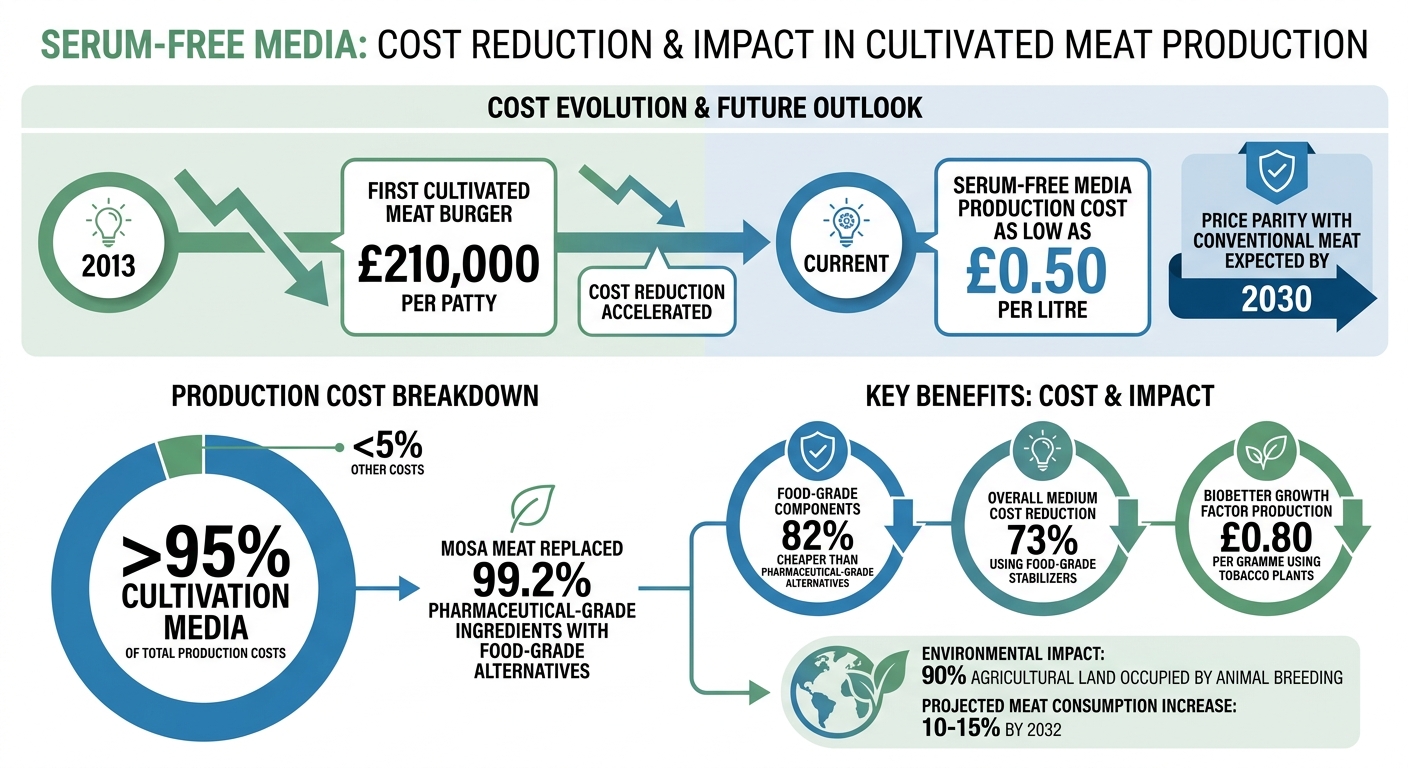
- Lower Costs: Early cultivated meat was prohibitively expensive (£210,000 per burger in 2013). With SFM, production costs have dropped dramatically, with media now costing as little as £0.50 per litre.
- Improved Safety: SFM ensures consistent quality and eliminates contamination risks tied to animal-derived products.
- Environmental Benefits: Cultivated meat uses far less land and resources compared to livestock farming, helping to reduce strain on natural ecosystems.
- Market Growth: Companies are achieving regulatory approvals, and cultivated meat is becoming more accessible in the UK, starting with pet food in 2024.
SFM is driving cultivated meat closer to your shopping basket by making it safer, cheaper, and more aligned with ethical and environmental goals.
What Is Serum-Free Media and Why Does It Matter?
What Serum-Free Media Is
Serum-free media is a specially formulated nutrient solution designed to support cell growth without relying on Fetal Bovine Serum (FBS). Instead, it uses a carefully balanced basal medium containing glucose, salts, amino acids, and supplements like growth factors and recombinant proteins that mimic the functions of natural serum [1].
Compared to traditional media, which can vary in composition and pose contamination risks from animal pathogens, serum-free media offers a "fully defined" formulation. Each component is precisely measured, ensuring consistent quality and reducing concerns about food safety [1]. This shift also eliminates the use of animal-derived ingredients in the production process.
How Serum-Free Media Reduces Environmental Impact
Serum-free media doesn't just improve consistency and ethics - it also plays a role in reducing environmental strain. Cultivated Meat production, for instance, uses far less land than conventional livestock farming. Considering that around 90% of agricultural land is currently occupied by animal breeding, this is a significant step forward [2]. By enabling scalable Cultivated Meat production, serum-free media contributes to a food system that emits fewer greenhouse gases and uses natural resources more efficiently.
Additionally, the industry is adopting a circular bioeconomy approach by incorporating agricultural by-products like soybean meal, rapeseed protein, and okara into serum-free media formulations [1]. This reduces waste and helps lower production costs. A great example of this is Mosa Meat's collaboration with Nutreco, where they replaced 99.2% of their basal cell feed with food-grade components - achieving cell growth rates comparable to pharmaceutical-grade media [1].
sbb-itb-c323ed3
Dr. Peter Stogios: Low-cost growth factors for serum-free media
How Serum-Free Media Benefits Consumers
Serum-Free Media Cost Reduction and Impact on Cultivated Meat Production
Lower Production Costs
Serum-free media is reshaping the cost dynamics of cultivated meat production. Right now, cultivation media makes up over 95% of total production costs [2], standing as the biggest hurdle to making cultivated meat more affordable. By swapping out costly pharmaceutical-grade components for food-grade alternatives, manufacturers can slash these expenses significantly.
Food-grade media components are, on average, 82% cheaper than their pharmaceutical counterparts. For instance, using food-grade stabilisers like methyl cellulose (a widely used food emulsifier labelled as E461) and common ingredients such as corn or rice starch can reduce medium costs by 73% overall [1][2]. Some companies have already achieved production costs as low as half a pound per litre [1].
These savings bring cultivated meat closer to being commercially viable. To put this into perspective, the first-ever cultivated meat burger - created by Professor Mark Post in London back in August 2013 - came with a hefty price tag of €250,000 per patty (around £210,000) [2]. Beyond affordability, serum-free media also improves safety standards, resulting in a higher-quality product.
Better Food Safety and Quality
For UK consumers, who are increasingly mindful of where their food comes from and its quality, serum-free media addresses critical safety concerns tied to animal-derived ingredients. Fetal bovine serum, for example, can carry animal pathogens and has inconsistent quality due to batch-to-batch variation. In contrast, serum-free media is fully defined, meaning every ingredient is precisely identified, measured, and controlled [1][2].
According to Scientific Reports, cultivated meat offers a future alternative that is ethical, environmentally friendly, and free from antibiotics [2].
This level of precision allows for antibiotic-free production and ensures consistent product quality. Additionally, the use of food-grade components like methyl cellulose - already approved for human consumption - further enhances safety standards compared to traditional meat production methods.
Increased Availability in the UK
The combination of reduced costs and improved safety is making cultivated meat more accessible. In July 2024, Meatly gained regulatory approval in the UK to produce cultivated pet food, marking a major step forward and proving the viability of serum-free production methods in the British market [1].
These developments are turning cultivated meat into a realistic option for everyday consumers. As production costs drop further and regulatory frameworks evolve, UK shoppers may soon see cultivated meat moving from a niche product to a regular feature in their weekly grocery shops.
Companies Using Serum-Free Media
Leading Companies and Their Progress
Several companies are making strides in serum-free media development to bring cultivated meat closer to UK consumers. One standout is Mosa Meat, which has been at the forefront of this field since 2013. By 2019, they had successfully removed all animal components from their process [4].
In January 2022, Mosa Meat published a study in Nature Food showcasing their ability to achieve muscle differentiation in bovine cells without using foetal bovine serum (FBS) or genetic modification. This breakthrough was spearheaded by CEO Maarten Bosch and a team of scientists, including Dr Joshua Flack and Tobias Messmer. They utilised RNA sequencing to identify cell surface receptors that, when activated, allow cells to mature into muscle fibres [4].
"This is really a milestone for us and for the cultivated meat field, because there's no method out there that describes the differentiation of primary satellite cells if you don't want to use FBS or genetically modify your cells." - Dr Joshua Flack, Scientist, Mosa Meat [4]
Mosa Meat has chosen to openly share its findings, reflecting its commitment to transparency. CEO Maarten Bosch explained:
"Although the decision to publish this information could be seen as competitively sensitive, we highly value openness and transparency for the advancement of the entire cellular agriculture field" [4]
This scientific progress not only advances the field but also contributes to reducing production costs, a key factor in making cultivated meat more accessible.
Cost Reductions in Serum-Free Media
Innovations like these are driving down costs in a significant way. Mosa Meat has replaced 99.2% of costly pharmaceutical-grade ingredients with food-grade alternatives, cutting expenses while maintaining - and even improving - quality.
Tim van de Rijdt from Mosa Meat highlighted this achievement:
"We've succeeded in developing our own entirely animal component-free growth media, which are performing really well. Under certain conditions, their media even outperforms FBS-based alternatives" [3]
These developments are crucial for making cultivated meat more affordable for UK consumers, bringing it one step closer to mainstream availability.
What Serum-Free Media Means for the Future
Expected Price Changes
The development of serum-free media (SFM) is significantly reducing production costs and could help cultivated meat match the price of conventional meat by 2030. Right now, SFM accounts for more than half of the variable operating costs in cultivated meat production [1]. According to npj Science of Food, "Advancements in SFM technology will be major drivers for cultivated meat to reach price parity with conventional meat" [1].
Companies like Believer Meats and BioBetter are already showcasing cost-efficient methods using SFM. For example, BioBetter uses molecular farming in tobacco plants to produce growth factors at approximately £0.80 per gramme [1]. Switching from pharmaceutical-grade to food-grade components has also resulted in notable cost reductions [1]. By incorporating food-grade raw materials and agricultural by-products, production costs are expected to continue decreasing as the industry scales. This shift will make cultivated meat an increasingly viable competitor to traditional meat in the UK market. Beyond cost efficiency, these advancements also reflect a broader move towards a more ethical and environmentally conscious food system.
A More Ethical Food System for UK Consumers
Serum-free media is not just about cutting costs - it’s also reshaping the ethics of meat production. By eliminating the use of foetal bovine serum, a significant ethical concern is removed from the process [1]. Additionally, cultivated meat requires far less land compared to traditional livestock farming, a crucial benefit as global meat consumption is projected to increase by 10–15% by 2032 [1].
The UK is making regulatory progress as well. In July 2024, Meatly received approval to produce cultivated pet food, marking a key milestone in bringing these innovations closer to everyday use [1]. As the technology advances, UK consumers can anticipate cultivated meat products that not only meet high standards for animal welfare and environmental care but also become more affordable over time. This evolution signals a promising future for a more sustainable and responsible food system.
Conclusion
Serum-free media represents a major step forward in the development of cultivated meat, helping to lower costs, improve safety, and address ethical concerns tied to animal-based ingredients. Recent advancements have significantly reduced production expenses, bringing cultivated meat closer to matching the price of traditional meat. This progress not only makes it more affordable but also strengthens its ethical appeal. This shift is part of a broader guide to cultivated meat ethics and sustainability. The chemically defined nature of serum-free media ensures consistent quality across batches and minimises contamination risks - key factors for gaining regulatory approval and building consumer trust.
In the UK, regulatory progress highlights how cultivated meat is steadily moving towards becoming a regular, sustainable choice for consumers. For those curious about this innovative alternative, Cultivated Meat Shop provides a reliable source to delve into the science and potential of cultivated meat.
FAQs
Will Cultivated Meat made with serum-free media taste different?
Cultivated meat grown with serum-free media might have a different taste profile due to how the growth media affects its flavour, aroma, and texture. The media supplies crucial nutrients that play a role in shaping the meat's savoury qualities, depth of flavour, and overall firmness.
Is serum-free media completely animal-free?
Serum-free media in cultivated meat production isn't always completely free of animal-derived components. While some formulations avoid using any animal-based ingredients, others might still include them, depending on the recipe. It's essential to review the specifics of the media to ensure transparency.
When will cultivated meat be available for people to buy in the UK?
Cultivated meat isn't on the shelves in the UK just yet, but things are moving forward. Regulatory processes are progressing, and developments such as serum-free media and scalable bioreactors are paving the way to make production more affordable. Though there's no confirmed timeline, it's possible that cultivated meat could become available to UK consumers by the late 2020s as these challenges are tackled. In the meantime, The Cultivated Meat Shop is focusing on educating and raising awareness among consumers.